


Twin pipelines run from Ramree Island and Maday Island on the western Burmese coast. The first carries gas from offshore fields in the Andaman Sea; the second carries shipments of crude oil from the Middle East and Africa. The pipes crawl east for hundreds of miles across northern Myanmar, eventually crossing the border and finding their respective termini in the Chinese cities of Guigang and Kunming. This is a good investment for China: the oil pipeline alone cuts transport distances by 1,200 km. But it’s an ever-present mockery of the Burmese population, two-thirds of which has no access to reliable electricity. Four off-take stations allow Myanmar to use just twenty percent of the gas.
The pipelines are part of the China–Myanmar Economic Corridor (CMEC), a multifaceted infrastructure project that Chinese President Xi Jinping has called the “priority among priorities” for his Belt and Road Initiative (BRI). Indeed, the CCP sometimes gives the impression that this is how it views the entire state of Myanmar—as one long economic corridor for Party purposes; an extended anteroom to China itself. But the true value and purpose of this infrastructure will only emerge in the great crises of the future. China ships eighty percent of its crude through the Strait of Malacca, which links the Indian Ocean to the Pacific. In the event of war with the United States over Taiwan, that strait is likely to be compromised. Alternative energy routes would suddenly become vital to the Chinese economy. And so, for now, those precious pipelines must be kept pristine.
That is not an easy job, since Myanmar is ablaze with civil war. A patchwork of militias and ethnic rebel armies battle the Tatmadaw (armed forces representing a junta that stole power in February 2021), while also fighting against each other. Beijing has sold the Tatmadaw more than US$250 million in arms, to minimal effect. Even “highly simplified” maps of Myanmar’s contested regions show a state fractured to the point of incomprehensibility—a piece of smashed glass on the world stage resembling the last stages of the Holy Roman Empire more than any modern nation-state. And the picture is shifting all the time.
Almost three million citizens have been displaced since the coup. There are fears of famine and starvation. Many people hide in the jungle, where they rely on Elon Musk’s Starlink. Beijing has begun flying mercenaries into the country, but not to fight alongside any of the combatants. Their job is very clear: protection of CCP assets.
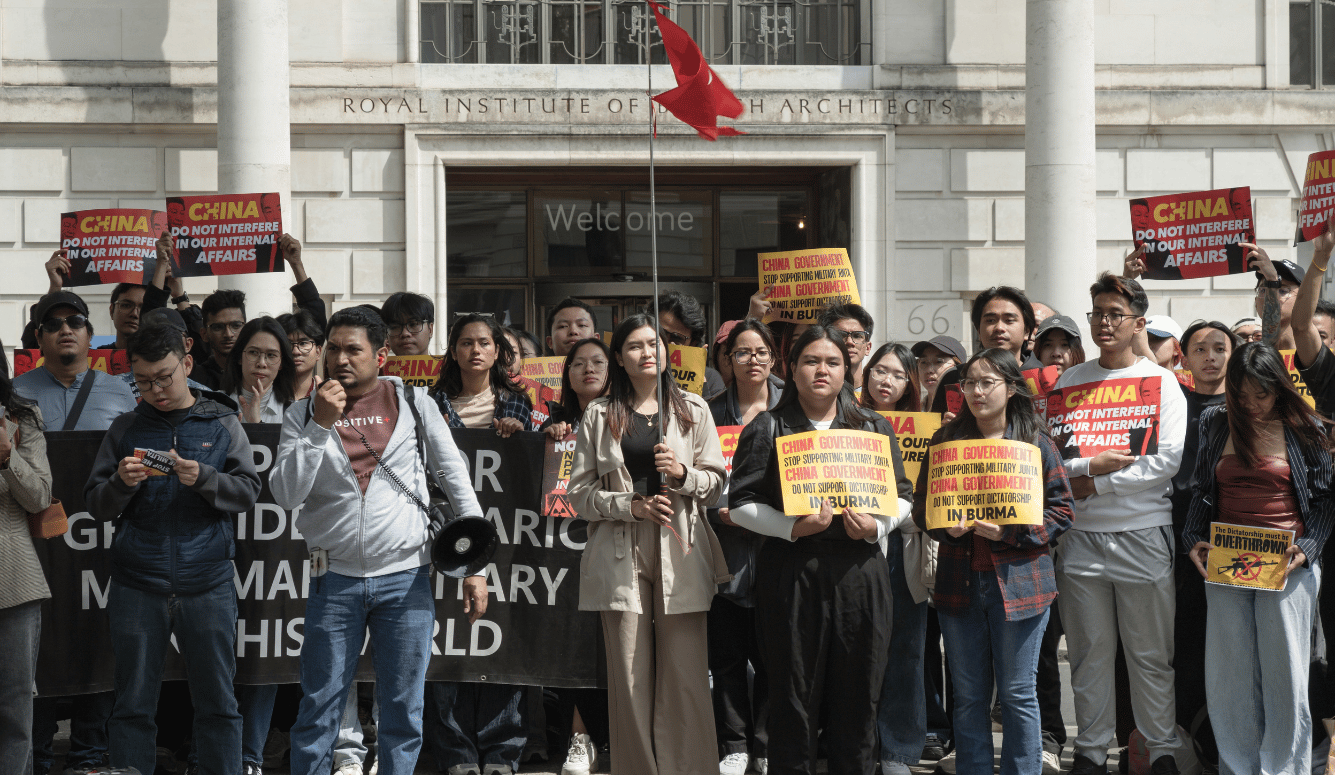
Myanmar’s resistance is struggling to hold back a tide of public anger at CCP support for the coup. Netizens have said they will “blow up” the pipes, which represent China, and there have been several guerrilla attempts to carry out that threat. After Beijing gave instructions to tighten pipeline security, the junta fell in line, no doubt worried about the flow of munitions arriving from various Chinese proxies. In some places, the pipes are now thought to be so well-protected that civilians will even choose to shelter in their shadow, hiding from the country’s endemic violence. Unfortunately for those civilians, Tatmadaw protection involves the planting of landmines in the woods near pipeline control centres. Farmers have stepped on mines while searching for their missing goats and buffalo.
Certain insurgent groups saw the leverage that might come with control of such geopolitically sensitive infrastructure. At the beginning of 2025, a militia calling itself the Arakan Army seized all sections of the pipeline in Rakhine state, save one. A few months later, a ragtag caucus of resistance groups captured off-take stations elsewhere in the country. The Arakan Army gave assurances that it would protect foreign investment projects in regions under its control, but that won’t help the leaders of the CCP to sleep any easier. They have to deal with the fact that sections of China’s future wartime provision now lie in the hands of clashing combatants, some of whom are highly unpredictable, in different parts of Myanmar.
This is a pattern that keeps repeating. In its quest to exploit Myanmar for diverse ends, the Chinese Communist Party underestimates the state’s volatility, and when things go wrong, the Party is left tangled in a web of complexities that it did not predict.
Consider the fallout from the Burmese cyberscam crackdowns. By late 2023, CCP officials had spent more than a decade cultivating close connections with Chinese crime families in Kokang, up in Myanmar’s north-east—the Wei, the Bai, the Liu, etc. These syndicates worked with Beijing on economic projects worth millions of dollars, and at the same time, they supervised hundreds of slave compounds buried deep within casino complexes. Here, the crime families housed tens of thousands of mostly Chinese prisoners. The latter had been lured or trafficked to Kokang, and then forced to work in online scam operations.
The prisoners were considered chattel. They worked seventeen-hour days, and slept eight to a cell. If they failed to meet their performance targets, they would be beaten with lead pipes. For attempting to escape, they would be waterboarded. Lions, tigers, and bears were kept in cages onsite: a warning of more horrific penalties for more serious transgressions.
The Communist Party had effectively offshored a lucrative criminal enterprise, transforming Myanmar (like Laos and Cambodia) into a “scam state” in the process. Those were the peak years of the Belt and Road Initiative, and Beijing viewed the Kokang families as guarantors of security in a strategically important region. So, the families enjoyed high status. As a Washington Post investigation revealed, the Lius would attend China-Myanmar border trade fairs, running booths alongside Huawei and China Telecom.
But once again, the Party was only creating problems for itself. After Myanmar’s 2021 coup, the cyberscam operations expanded (thanks to Tatmadaw protection), the number of Chinese victims grew, and Chinese public indignation grew along with it. When dealing with social unrest within its own borders, the CCP has always lurched between the poles of heavy repression and hasty retreat. On this occasion it opted for the latter. The Party decided to crack down on an industry it had long protected, and teach a lesson to the Tatmadaw in the process.
Beijing gave the green light, and the region’s dominant militia—the Myanmar National Democratic Alliance Army (MNDAA)—proceeded to raid compounds, arresting and deporting ringleaders. Today, the Kokang casinos lie empty, save for a smattering of MNDAA guards who stand watch, and the last few tigers and bears prowling their cages in the dark. The MNDAA quickly pressed its advantage, joining forces with another two militias up in the jungled borderlands: the Arakan Army and the Ta’ang National Liberation Army. Neither is allied with the Burmese government-in-exile, and each has its own territorial ambitions. This loose alliance managed to take control of 220 Tatmadaw positions, alarming Beijing, which had not expected the junta to fold so fast.
The CCP—self-appointed final arbiter in Burmese affairs—ended its tacit support for the rebellion and declared a ceasefire. That was assumed to be the end of the matter. When Myanmar’s militias broke the ceasefire in 2024, Beijing became frantic, kidnapping one of the militia leaders, cutting off food and medicine supplies to militias and civilians alike, and conducting live fire drills along the border as a warning. Next came a surge of diplomatic overtures to the regime. The CCP has always refused to recognise the man in charge of the Tatmadaw as head of state—Myanmar’s usurper-in-chief Min Aung Hlaing. But in November 2024, Min Aung Hlaing was finally permitted to visit China (albeit only for a regional summit in Kunming, not the capital).
The nervous autocrats in Zhongnanhai had realised that an incompetent military junta is really far more suitable for their purposes than a chaotic rebel bloc. In addition, the Communist Party feels an affinity for fellow authoritarian regimes that took power by force. It does not welcome the collapse of any such regime—a reminder of its own illegitimate origins and ongoing instability.
We can see the same pattern again when it comes to Beijing’s resource exploitation. Kachin state (northeast Myanmar) is the source of almost half the world’s supply of heavy rare-earth elements, and the site of extensive illegal mining by Chinese companies. Kachin’s rare-earth industry never had much accountability, but after the junta’s coup in 2021, checks and balances dissolved faster than ores in a chemical leaching pool.
For the CCP, it was perfect. The rare-earth deposits now lay within a militarised, semi-autonomous zone (dubbed “Kachin Special Region 1”), a state-within-a-state that existed to serve Communist Party interests. In late 2024, however, the aforementioned ceasefire broke, and Kachin Special Region 1 was captured by an ethnic rebel force called the Kachin Independence Army (KIA). Today, those CCP interests look a lot less secure.
Desperate for a return to the previous arrangement, Beijing has ended up in the odd position of threatening to block Kachin’s rare-earth exports (the minerals are normally sent to China for processing) unless the KIA ends its offensive in Bhamo, a garrison town in the state. The junta’s loss of the town would weaken its control over trade routes in the north: an outcome Beijing has deemed unacceptable. But if those rare earths really are compromised, then we can expect global deficits and price hikes. The Chinese authorities won’t tolerate that for long either. If the militia prevails in the north, the Party will likely negotiate.
Unperturbed by all these setbacks, the CCP is forging ahead with further dubious plans for Myanmar. It has poured US$20 billion into seven hydroelectric dams across the country, and another US$7.3 billion into Kyaukphyu Deep-Sea Port, a seventy percent Chinese-owned development on the country’s west coast that should see completion this year. US$8.9 billion funds a cross-country railway project linking the port to China, thus potentially enabling Beijing—landlocked on its western border—to project power across the Indian Ocean.
Kyaukphyu is one of four particularly suspicious BRI projects that have been flagged as potential Chinese military bases (the other three are Gwadar in Pakistan, Hambantota in Sri Lanka, and Koh Kong in Cambodia). Of course, Myanmar’s constitution does not allow the deployment of foreign troops on its territory, but in practice, the country’s sovereignty is an open question. Myanmar owes billions to the CCP; Burmese politicians now travel to China to undergo indoctrination at the Central Party School. A military base is no longer such a far-fetched notion. Already, the People’s Liberation Army Navy (PLAN) has begun conducting port calls in Myanmar.
There is precedent. Under the guise of BRI development, Beijing spent years pumping investment into Djibouti, on the Horn of Africa. Fears of militarisation were dismissed as groundless. Even after Djibouti’s government signed a Security and Defence Partnership Agreement allowing access to the People’s Liberation Army (PLA), the CCP continued to make emollient noises: there was “no intention of turning the logistics centre into a military foothold.” And today? The PLA has a heavily fortified military base on Djibouti, complete with multiple aircraft hangars and underground bunkers.
Or recall the case of the Spratly Islands in the South China Sea. When Chinese companies began piling sand onto submerged reefs and seamounts in the region, fortifying the resultant structures with giant concrete seawalls, the world was told these new artificial islands were actually humanitarian projects. They would provide shelter for fishermen in bad weather. That narrative started to seem less convincing when airfields and hangars sprang up, but the CCP urged the international community not to jump to conclusions—these new features were for commercial use only. At a press conference in the White House Rose Garden, Xi Jinping personally assured Barack Obama that the Spratlys would never be militarised. Then fighter jets began appearing on the islands, along with laser and jamming equipment, radar systems, and anti-ship/anti-aircraft missile systems. The story switched again: these were all necessary defensive measures. But by this point, we had come a long way from friendly havens for storm-tossed fishermen.
“Only the irredeemably corrupt or the terminally naïve take seriously Beijing’s rhetoric about a Community of Common Destiny,” warns Bilahari Kausikan, a former Singapore diplomat. Much the same could be said of those who take seriously Beijing’s rhetoric of non-militarisation. Kyaukphyu will likely follow the same trajectory as Djibouti and the Spratly reefs.
This time round, however, it could be a messier process. The meddling in Burmese affairs, the extraction of Burmese resources, the siding with first one belligerent in the Burmese civil war and then another—these developments all add up to a poor recipe for trust. Myanmar’s various combatants may need Beijing for the moment, but none, surely, consider themselves to be dealing with a serious ally. Anti-China tensions are never far from the surface. In October, an explosion targeted the Chinese consulate in Mandalay; in April, the Tatmadaw opened fire on a Chinese Red Cross convoy carrying relief supplies.
Seeking stability, the CCP will orchestrate Myanmar’s upcoming general election (the first since the coup). This is the kind of election that Beijing understands best: naturally, the main opposition party is not permitted to take part. The plan is to cloak the junta in the colours of legitimacy, and to remove from power the hapless Min Aung Hlaing. We can expect the Party’s tampering to trigger another set of problems, further complicating one of the planet’s most intractable crises.
