


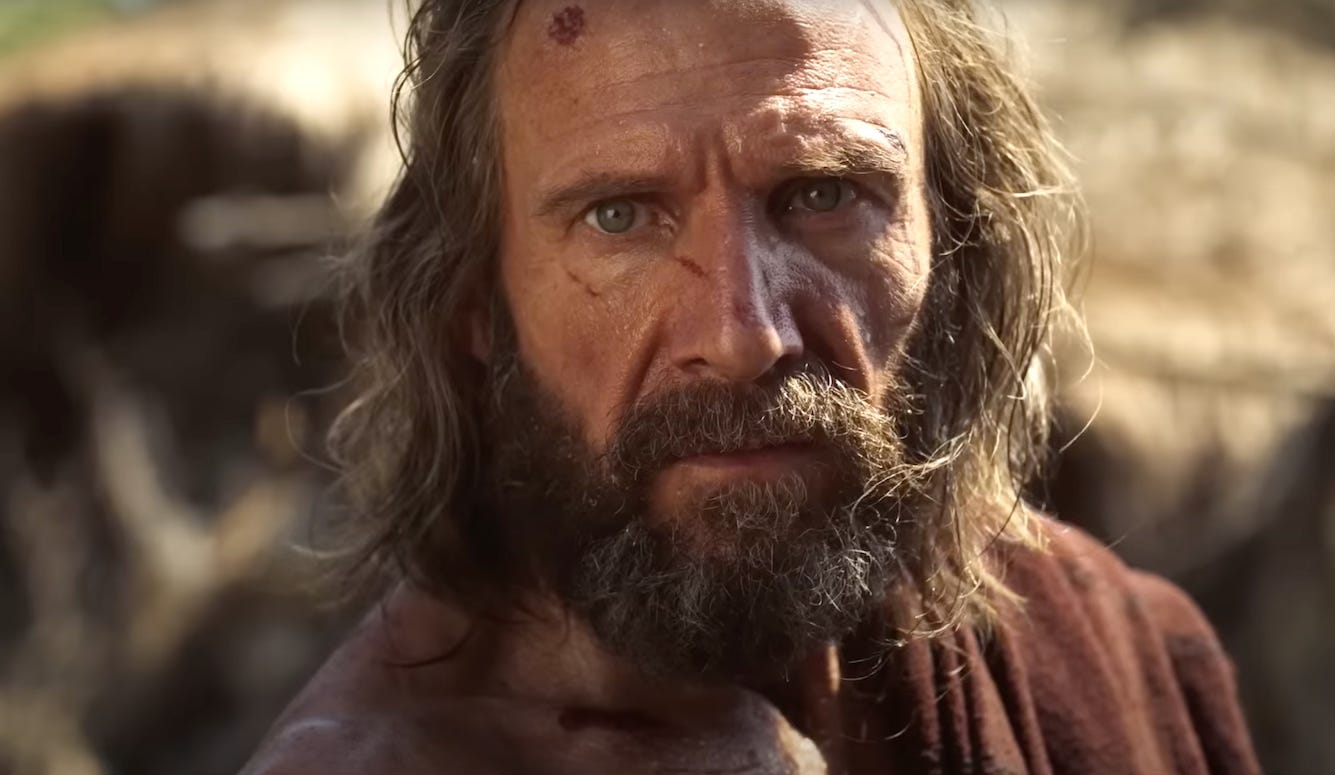
Homer’s Iliad is the first and greatest epic poem to have come down to us from ancient Greece. The Odyssey is the second. Homer is thought to have composed it in old age. Although this later epic is less powerful than the Iliad, it has been more influential, perhaps because the story seems universal—it’s about a tired old man who wants to go home and sleep in his own bed again. As every student of literature knows, James Joyce’s Ulysses is a retelling of the Odyssey updated to 20th-century Dublin. Joyce is by no means the only major writer to have adapted Homer’s epic to a new form, context, or language. But he is one of the few who succeeded. It takes great cunning to transform the Odyssey into something that modern audiences can enjoy.
Many of the people involved in Uberto Pasolini’s new screen adaptation of the Odyssey are intimidatingly talented. Ralph Fiennes and Juliette Binoche are two of the most gifted living screen performers, and among the younger cast members, Marwan Kenzari stands out as an exquisitely sinister villain. Even the musical score is the work of a distinguished professional: its composer Rachel Portman won an Oscar for her work on Emma in 1994. It’s a joy to experience the work of people like Fiennes, Binoche, Kenzari, and Portman, simply because they are so good at what they do.
It’s a pity, then, that The Return is a failure. Most of the blame lies with a misconceived screenplay. Pasolini’s unimaginative direction doesn’t help. It may be that the Odyssey’s reputation intimidated the director and screenwriters, who somehow manage to be too reverent towards their source material and not reverent enough. In any event, the upshot is a film that feels like a primitive piece of early 20th-century cinema, made before anybody had worked out how to develop a coherent feature-length narrative on screen or move actors around in a scene.
Homer and the Ancient Epic
Homer created the first two surviving literary works in the Western tradition, both of which enjoyed the status of sacred texts during antiquity. For over a thousand years, until the fourth century AD or so, every educated person in what eventually became the Roman Empire knew much of the Iliad and Odyssey by heart. And yet, we know nothing about the man who composed these poems. Despite Homer’s prestige, we have no idea who he was, when he lived, where he came from, or even whether or not he actually composed the Iliadand the Odyssey by himself.
(Anyone interested in venturing down a Homeric rabbit-hole can begin by consulting the relevant articles in the Oxford Classical Dictionary, The Cambridge Companion to Homer, Oxford Readings in Homer’s Iliad, and Oxford Readings in Homer’s Odyssey. Those interested in exploring further can buy a copy of the late Professor Martin West’s The Making of the Iliad and his similarly expensive The Making of the Odyssey. Even the most well-educated reader will feel ignorant after a few pages. Professor West’s books are worth every penny of their outrageous cover prices, even if some of his most striking ideas sound self-evidently mad.)
But let’s assume for the moment that the traditional stories are true—that Homer was a real person, a blind bard who was born at some point during the 8th century BC, composed the Iliad around or after 725 BC, and then wrote the Odyssey some time before 675 BC. The Iliad is fundamentally a tragic poem about virtue, honour, justice, and the pursuit of fame and everlasting glory in the face of hardship, suffering, injustice, and death. Much of its power lies in the sheer scope of Homer’s inspiration and awesome technical ability. Even a bad translation raises existential questions of a sort that can keep a person up at three in the morning.
The Odyssey, on the other hand, is a very different kind of epic. It has a happy ending that is telegraphed in advance, and its episodes often have the quality of a romantic fairy tale. Nevertheless, it is still a heroic epic. The hero, Odysseus is constantly in peril and survives with a combination of luck, cunning, physical prowess, and quick thinking, not to mention the advice and protection of the goddess Athena, who loves him and only allows him to suffer because suffering will make him a wiser man.
Homer—whoever he was—was more than just an entertainer. But the greater meaning of his work is difficult to spell out succinctly because he develops his major themes symbolically as well as in narrative form. There are lines and entire speeches—especially in the Iliad—that can be quoted out of context and mulled over at length. But there are no pat lessons imparted by either work, and attempts to extract them usually produce only unsatisfying bromides like “war is hell” or “death comes to us all.” Homer’s poetry cannot be reduced to a pithy summary.