


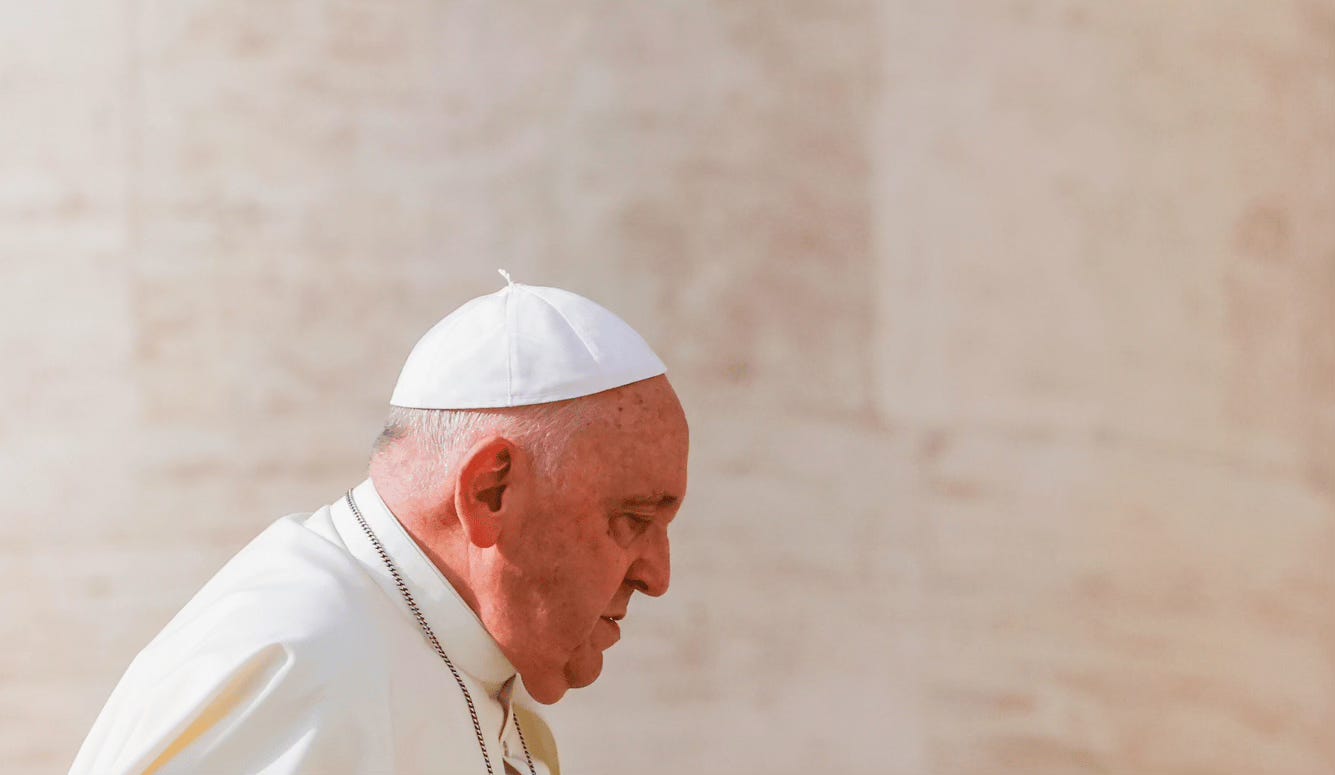
Christopher Hitchens used to say that, in modern society, a person’s character is judged by their reputation rather than the other way around. This phenomenon was particularly acute, he noted, when the representatives of faith-based institutions were under consideration. For some reason, religious figures are presumed to merit indulgence on complex matters of ethics and justice. This may be why Pope Francis, who is currently struggling with a bout of illness, enjoys a reputation today as a “lonely moral voice.”
That is, at any rate, the verdict delivered by David Gibson in a recent essay for the New York Times. Gibson, director of the Center on Religion and Culture at Fordham University, argues that the Pope puts “the needs and interests of others—including the least powerful—ahead of his own.” And it is this example of pious altruism, Gibson maintains, that has inspired 1.3 billion Catholics and anyone else who upholds the values of “humility and mercy” in a weary world.
If Pope Francis embodies humility and mercy, the social value of these qualities requires urgent reexamination. His commentary on the war in Ukraine has been perverse and contemptible. He has inveighed against the “madness” of Western democracies imposing sanctions on Russia and providing an invaded nation with the assistance it needs to defend itself. He has echoed Kremlin propaganda by accusing NATO of “barking” at Russia’s door. And he has repeatedly invoked Mahatma Gandhi’s injunction against national self-defence, insisting that there is no such thing as a “just war.”
Pope Francis has been no better on other matters of international security. In 2014, for instance, after the jihadist massacre of the Charlie Hebdo cartoonists in Paris, Francis declared that while killing in God’s name is an “absurdity,” freedom of speech had its limits and people really should not be mocking or insulting religious faith. One might have expected something more morally serious from a revered religious leader than a statement that sounds like a reader’s letter to the Guardian.
But Gibson wants to use Francis and his meek faith as a foil for Donald Trump’s deranged moral compass. This is a mistake, and the comparison deserves attention because it consecrates a familiar moral binary on the cultural and political Left. On one side, we are invited to recoil from Trump’s howling moral wilderness; on the other, we can contemplate Francis’s serene hostility to inhumane ideologies. But this false choice can only benefit Trump and other demagogues like him.
“The pope is no starry-eyed moralist,” Gibson assures us in a prophylactic bit of throat-clearing. “‘Reality is greater than ideas,’ as he likes to say, and he is realistic about how the world works.” To justify this rather extravagant claim, Gibson cites Francis’s hatred of “ideologies that hijack minds” as well as his fondness for “the old fashioned politics that gets stuff done.” However, this sits uncomfortably with Gibson’s fatuous assertion that, having pushed for “an inclusive church and an inclusive world,” Francis “was a DEI exponent before that became a bad thing.” After all, this plaintive attempt to dress up DEI as something morally righteous is nothing if not an ideological argument.
Still, if political commitments occasionally seep into the papal worldview, it is still firmly arrayed against power and other tragic elements of the human condition in a fallen world. At a time when America is discarding its foundational values, Gibson contends, it is the Vatican under Francis that is adhering to them most scrupulously. He reminds us that Villanova theologian Massimo Faggioli recently remarked: “In this time of neo-imperial powers, I suspect that the Catholic Church is the best anti-empire that we have.” But this sentence is wrong twice. First, it is ahistorical to suggest that America’s liberal principles can be upheld without hard power. And since a pacifist anti-empire is of no use against the bandit empires of our day, the Catholic Church lacks the means to advance global security and welfare.
The professed anti-politics of Pope Francis and his apologists amounts to little more than a plea for sentimental technocracy, and there is nothing remotely old fashioned about that. It is, in fact, a thoroughly modern (not to mention specious) conception of the role of government. Politics is, as Henry Adams said, “the systematic organization of hatreds.” That Francis objects to the division of the world “into friends to be defended and foes to be fought” does not make him some kind of conservative throwback; it makes him a zealous puritan, profoundly ill-suited to the political arena, to say nothing of the geopolitical jungle.
➜ Read the full article at Quillette.com
Note: Quillette maintains its independence through reader subscriptions. You'll need a subscription to access the complete article.