

Folk, Feedback, and Fury
Neil Young is eighty. By David Cohen
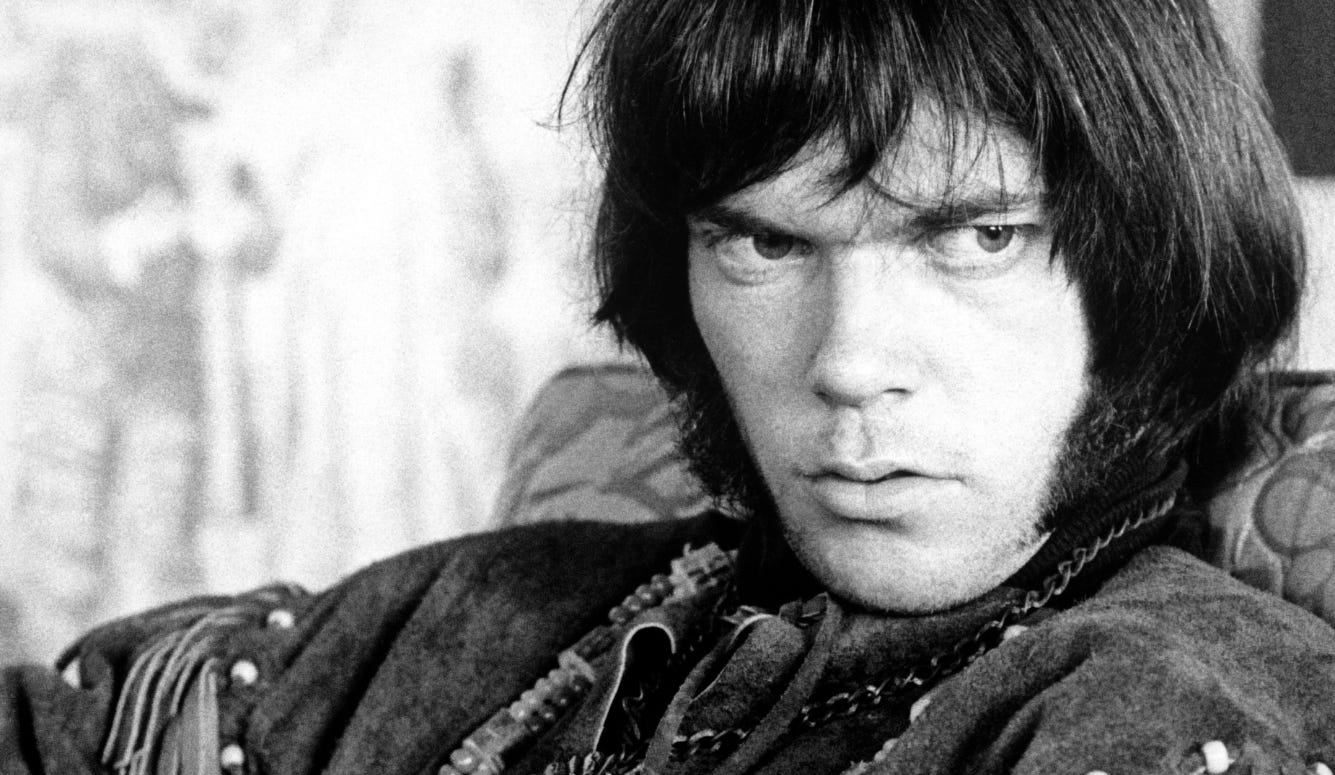
“Listen to your own voice,” Neil Young once remarked. “Don’t listen to someone else’s. To me the way to live is to always move forward—to keep searching for whatever it is that interests you.” At eighty, Young is still a defiantly idiosyncratic songwriter and a singer and instrumentalist so raw and ragged that his music feels like a protest against polish. One of rock’s mad masters of excess, he has always moved too fast, and overdone more or less everything he has turned his gnarled hand to. “It’s better to burn out than to fade away,” he famously declared in a lyric that would find its way into Kurt Cobain’s parting thoughts. And after nearly fifty studio albums and countless live performances, Canada’s spikiest artist is still at it.
That’s good news for anyone who has followed him since he first displayed his tremendous songwriting talent in the mid-1960s. His thin vocal might be a little rustier these days, but it never sleeps. Nor does his willingness to pick fights with high-profile targets. Most recently, he threatened to remove all of his songs—more than a thousand of them—from Amazon Music because Jeff Bezos is too cozy with the Trump administration. “Forget Amazon,” Young instructed his fans in a post on the Neil Young Archives site. “Buy local. Buy direct. Bezos supports this government. It does not support you or me.” In August, he quit Facebook over its “unconscionable” use of chatbots with minors. He has also declared that he is done with X and Elon Musk, whom he has accused of promoting antisemitism in a retweeted message.
Perhaps the biggest spat of all occurred in 2022 after Young yanked all of his records from Spotify, ostensibly as a stand against the platform’s lucrative relationship with podcaster Joe Rogan. Young accused Spotify of propagating COVID “misinformation” through Rogan’s show, which the music streamer had earlier bought in a deal reportedly worth at least US$100 million. Financially, Young never stood to lose much from that decision. He had just sold fifty percent of the publishing rights to his own back catalogue to the investment firm Hipgnosis Songs Fund for an estimated US$150 million. Still, his reputation probably ended up taking a bit of a hit, and the only other notable star to follow his lead was his old friend Joni Mitchell.
A couple of years ago, Young returned his music to Spotify (as did Mitchell). Since plenty of others were still serving “the same disinformation podcast features,” he explained, he felt his protest gesture had run its course. But the questions it raised remained. Young’s sporadic temper tantrums seem to be consistent with his idea of ethical living, but some of his fans have begun to wonder what they actually achieve. Streaming services and social media have made music more accessible than ever, the argument goes. By stepping away from these platforms, isn’t Young just making it harder for fans—and younger fans, in particular—to find and enjoy his work?
Young’s behaviour raises broader questions, as well. Should consumers choose services based on political beliefs? Can we separate an artist’s message from the medium through which it’s delivered? “Freedom of choice is meaningless without knowledge. That’s why it’s crucial we all get engaged and get informed,” Young has said, in defence of his belief in the importance of awareness and action. That’s debatable, I suppose, but as with so many other artists, Young’s politics and activism are not as interesting as the shimmering back-catalogue he has produced during a career of furious intensity.
