

Four years ago, a colleague asked me whether I could chair a debate with some guy called ‘Gary Stevenson’, who was, apparently, an anti-inequality campaigner and a YouTube commentator of some description. I had never heard of Stevenson, but accepted. The debate went all right, even though it was mostly a case of talking past each other (which, given that I was the moderator, was probably my fault). It was otherwise not especially memorable. Britain does not exactly have a shortage of left-wing media figures and activists. In the first half of the 2010s, there was the campaign for a ‘Robin Hood Tax’, the anti-tax-avoidance campaign ‘UK Uncut’, the ‘People’s Assembly’ with its endless anti-austerity marches, the Occupy movement, and, later, the political cult around Russell Brand. From 2015, all of these movements coalesced around Corbynism, and while Jeremy Corbyn himself stepped down as Labour leader in 2020, the movement lingered.
Stevenson was slightly different because of his unusual backstory as a former City trader, and because of his singular focus on wealth inequality as opposed to, for example, income inequality, nationalisation, or price controls. Nonetheless, I saw him as just another minor character in Britain’s vast left-wing ecosystem.
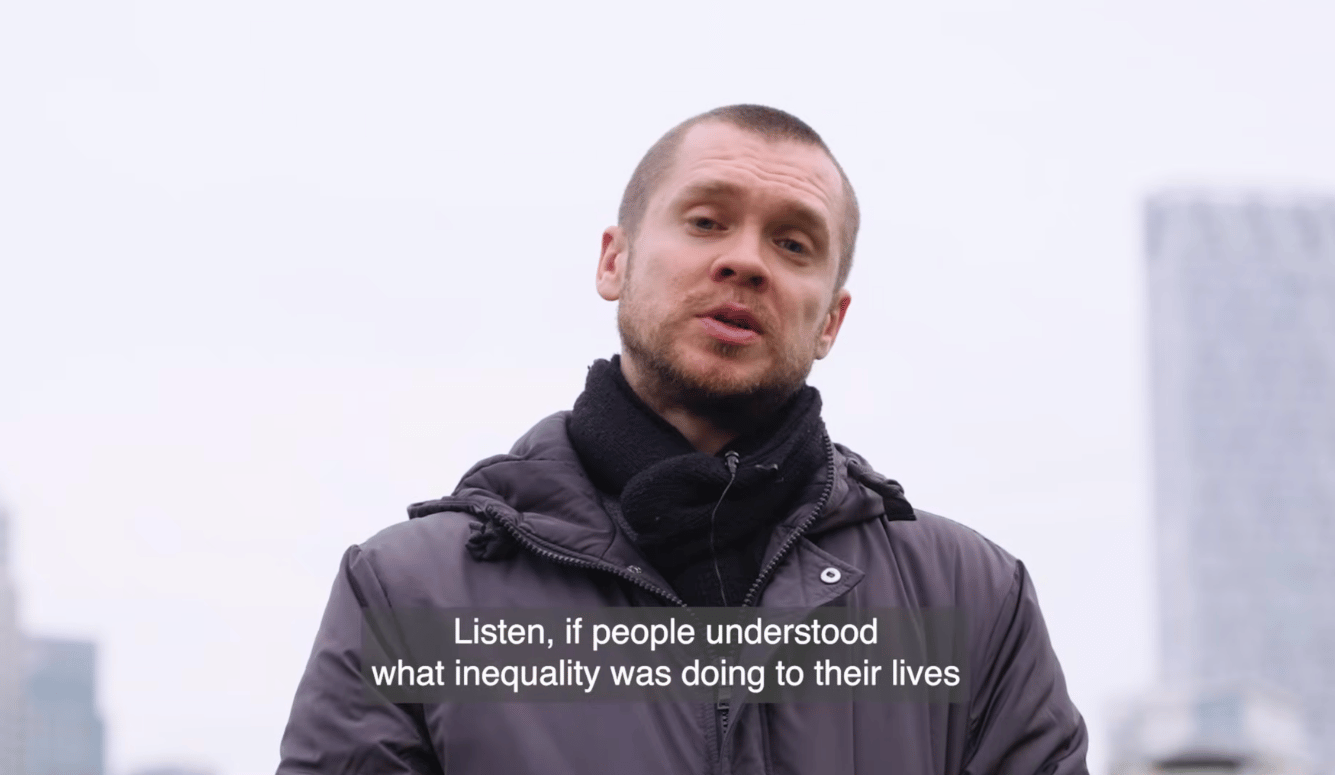
Today, four years on, Gary Stevenson is everywhere. He is a best-selling author, his YouTube channel ‘Gary’s Economics’ has more than 1.6 million subscribers, he is all over the media, and Channel 4 have just released an entire documentary about him. Four years ago, the wealth tax, Stevenson’s flagship policy, was a niche idea that only a bunch of tax nerds were interested in. Today, it is the policy idea of the hour, with three-quarters of the public expressing support for it. Stevenson even sells T-shirts with pro-wealth-tax slogans.
While his book The Trading Game was more autobiography than economic manifesto, the Channel 4 documentary, How to Get Filthy Rich, is mostly about ‘Garynomics’. Stevenson’s economic theory, which he first set out in his Oxford dissertation, The Impact of Inequality on Asset Prices When Households Care About Wealth, goes roughly as follows:
Wealth inequality has a positive feedback loop. It feeds on itself. Wealth inequality leads to greater wealth inequality, which then leads to even greater wealth inequality. And in the process, it destroys the economy.
How so?
Imagine our starting point is a relatively egalitarian, relatively prosperous economy. Most people have some asset wealth, but hardly anyone is super-wealthy. Now, for whatever reason, inequality increases. The richest cannot spend all their extra money on consumer goods and services, because they already have everything that money can buy. So what do they do? They buy assets. In doing so, they push up asset prices, making those assets unaffordable to people at the opposite end of the wealth distribution. The economy as a whole suffers, because consumer spending decreases. People run down their savings, get into debt, sell off their assets. Who do they owe that debt to? Who do they sell their assets to? The wealthy, of course. Who become even wealthier in the process, and use their extra wealth to buy more assets, driving up asset prices further, causing an even greater concentration of wealth, while sucking consumer demand out of the economy. This triggers another round of the same process. And so on, until the bitter end, which is a neo-feudalist dystopia in which a few plutocrats own everything, while the rest of the population are immiserated.
The only way to break this vicious cycle, in Stevenson’s theory, is to constrain the wealth of the super-wealthy, ideally with a wealth tax, to give the rest of society a break. Stevenson is not a communist, and he is not ‘anti-rich’ either. But he is convinced that capitalism, left to its own devices, produces a wealth inequality death spiral. Stevenson thinks that the British economy is currently at an advanced stage of that spiral, and that things are only going to get worse unless corrected.
It’s an economic theory. It’s a good story.
Is it true, though? Does this actually happen?
That would have been a good question for a documentary of this kind to explore. How to Get Filthy Rich does not do that. At all. It simply treats Stevenson’s theories as self-evidently correct, and gives him all the airtime he needs to repeat his assertions about exploding wealth inequality.

