

Gender Bending Mobster Mash
By Charlotte Allen.

NOTE: This essay contains spoilers.
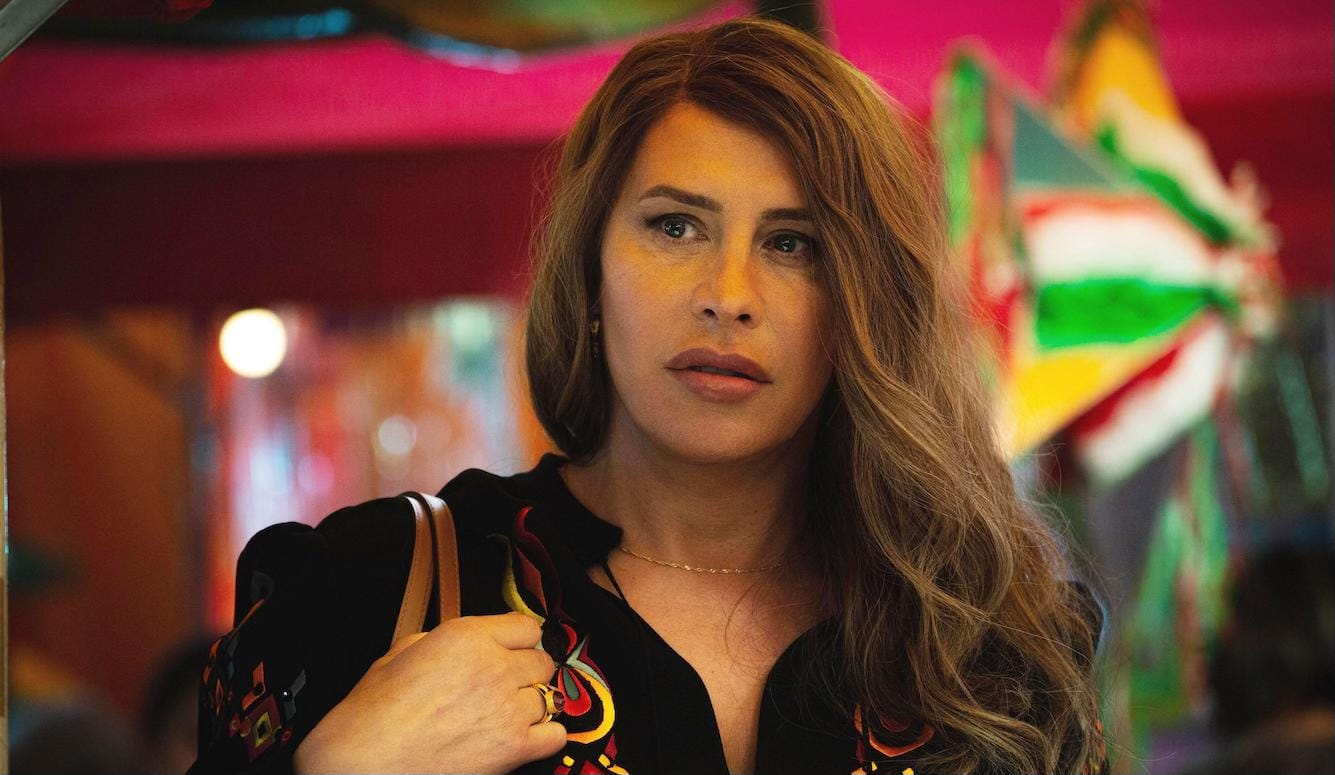
The rise and fall of Jacques Audiard’s Spanish-language movie musical Emilia Pérez must be one of the swiftest turns of the wheel of cinematic fortune ever recorded. On 23 January 2025, the Academy of Motion Picture Arts and Sciences announced that the Netflix-distributed film had been nominated for thirteen Oscars—the second-highest number of nominations in the Academy’s history. The kudos list included Best Picture, Best Director (Audiard), and most importantly, Best Actress for Karla Sofia Gascón. Gascón is a transwoman who plays a cartel lord named Manitas and the titular woman he becomes after faking his death and undergoing a sex-change operation to avoid elimination by his business rivals. Had Gascón won in her category, she would have been the first biological male to carry away a statuette intended to honour female performances.
Instead, at the awards ceremony on 2 March, Emilia Pérez won a paltry two Oscars, both pointedly aimed at Gascón’s costar, Zoe Saldaña, who plays a young Mexico City lawyer named Rita, whom Manitas hires to arrange the legal and medical aspects of his transition. Saldaña won Best Supporting Actress, and a show-stopping number sung by Saldaña won Best Original Song. The film was otherwise snubbed by Academy voters because, on 30 January, just a week after the Academy announced its nominations, it emerged that Gascón had posted a series of very unprogressive tweets in 2020–21. Not only had she criticised Islam in quite strident terms, but she had also expressed her disdain for the canonisation of George Floyd, a black man who died in police custody in May 2020.
So, Karla Sofia Gascón was duly cancelled. Netflix pulled her from its promotion machine, Audiard publicly suspended all further communication with her, and the Academy decided to advertise its progressive bona fides by rewarding a film about a sex worker instead. Sean Baker’s Palme D’Or winner Anora, which stars Mikey Madison as a lap-dancer and part-time prostitute, walked away with five Oscars, including Best Picture, Best Director (Baker), Best Actress (Madison), Best Original Screenplay, and Best Film Editing.
This was quite a turnaround. Back in May 2024, Emilia Pérez had received a rapturous reception after it premiered at the Cannes Film Festival. There, Gascón, Saldaña, and the film’s two other leads—Selena Gomez and Adriana Paz—jointly received a Best Actress award and the film itself picked up the Jury Prize. It also collected four Golden Globes, three Critics’ Choice awards, and two BAFTAs amid a flurry of lesser prizes. The critics mostly raved. “Very rarely does the right movie arrive at precisely the right time, at a moment when compassion appears to be in short supply and the collective human imagination has come to feel shrunken and desiccated,” enthused Stephanie Zacharek in Time on 13 November 2024 shortly after Donald Trump’s reelection as US president. Emilia Pérez’s theme of gender transition had seemed irresistible, because it combined fashionable feminist notions of “toxic masculinity” with a contrasting portrait of feminine sensitivity. Filled with remorse about the brutal ruthlessness of her life as Manitas, Emilia enlists Rita to help establish an NGO dedicated to locating the bodies of drug-war victims, thereby providing closure to grieving relatives.
Sarah Haji, the journalist who found and posted Gascón’s old tweets on 30 January, has described herself as a “Black Muslim” (she wears a hijab in her X profile pic). “[I] have never seen tweets this racist from someone actively campaigning to win an ACADEMY AWARD,” Haji exclaimed. The tweets certainly displayed a pretty frank animus against Muslims: “[H]ow many times will history have to expel the Moors from Spain,” read the Google translation of Gascón’s Spanish that Haji posted. But these intemperate thoughts also represented an understandable reaction to specific acts of Islamic terrorism in European cities, including a beheading in Nice in October 2020 by an illegal Tunisian immigrant who was already awaiting deportation from Italy. “[T]heir religion is INCOMPATIBLE with Western values,” Gascón had tweeted. She had also called George Floyd a “drug addict swindler,” which was not an inaccurate description, but nor was it likely to endear her to Academy voters.
Around the time that Haji’s revelations appeared, some critics began to murmur that Emilia Pérezwas really not a such wonderful movie after all. It might, in fact, be terrible and amateurish, and heaped with prestigious nominations for obviously ideological reasons. The film had bombed in Mexico, where it played briefly during the fall of 2024. It had been shot almost entirely in Audiard’s native France, so the settings didn’t look Mexican to people who actually lived where the story was supposed to take place. Complaints surfaced that neither Saldaña, who is Dominican in ancestry, nor Gomez, who is a second-generation Mexican-American, could speak Spanish with a credible Mexican accent. (The screenplay tries to cover for this by making Saldaña’s character Dominican-born and telling us that Gomez’s character was raised in America. Gascón, a Spanish native and current resident, is more believable because she had had a long career as a male actor in Mexican telenovelas before transitioning in 2018 at the age of 46.) It didn’t help that Audiard knows no Spanish himself and had written his screenplay in French and had it translated. And LGBTQ activists complained that the film promotes a “binary” and stereotyped view of gender identity, despite its lip service to the trans ethos.
In fact, Emilia Pérez is not as bad as its critics now say it is. That doesn’t mean it’s not a bad movie. It’s still pretty bad. Paul Guilhaume’s cinematography, for example, might have snagged an Oscar nomination, but it’s generally mediocre: urban-panorama shots of the film’s shifting locales (Mexico City, London, Bangkok, Tel Aviv, back to Mexico City) that look like stock footage; boxy interior shots (from Audiard’s Paris studio) that look like sets in a filmed stage play; and an impenetrable murkiness in the night scenes that make it hard to see what is going on during the movie’s dénouement. And I don’t really understand why Juliette Welfling received a Best Editing nomination. Was it for the clichéd split screens? Or the jump cuts that suddenly turn sombre scenes of solo introspection into cheery ensemble musical numbers? Or the closeups of Emilia’s long, chorizo-like fingers with their manicured nails filed into icepick points?
Much of the acting is indifferent as well, although that might have been the fault of Audiard’s screenplay, adapted from Boris Razon’s 2018 novel Écoute, in which Zoe Saldaña’s Rita was a man. Audiard’s script, or perhaps his direction, leaves most, if not all, of the other characters besides Emilia without much to do. Saldaña’s Oscar-winning musical tour de force, “El mal,” in which she leaps onto tabletops attired in a red velvet pantsuit at one of Emilia’s fundraiser galas and excoriates the businessmen, politicians, and judges for their complicity in Mexico’s deadly drug trade, is indeed impressive. But that’s about all the drama that Rita is given.
➜ Read the full article at Quillette.com
Note: Quillette maintains its independence through reader subscriptions. You'll need a subscription to access the complete article.
But on the website we can’t listen to the article