

Gentrifying the Intifada
Zohran Mamdani’s brand of socialism appeals to the luxury beliefs of New York’s middle classes. If his preferred policies are implemented, the poorest New Yorkers will suffer the most.


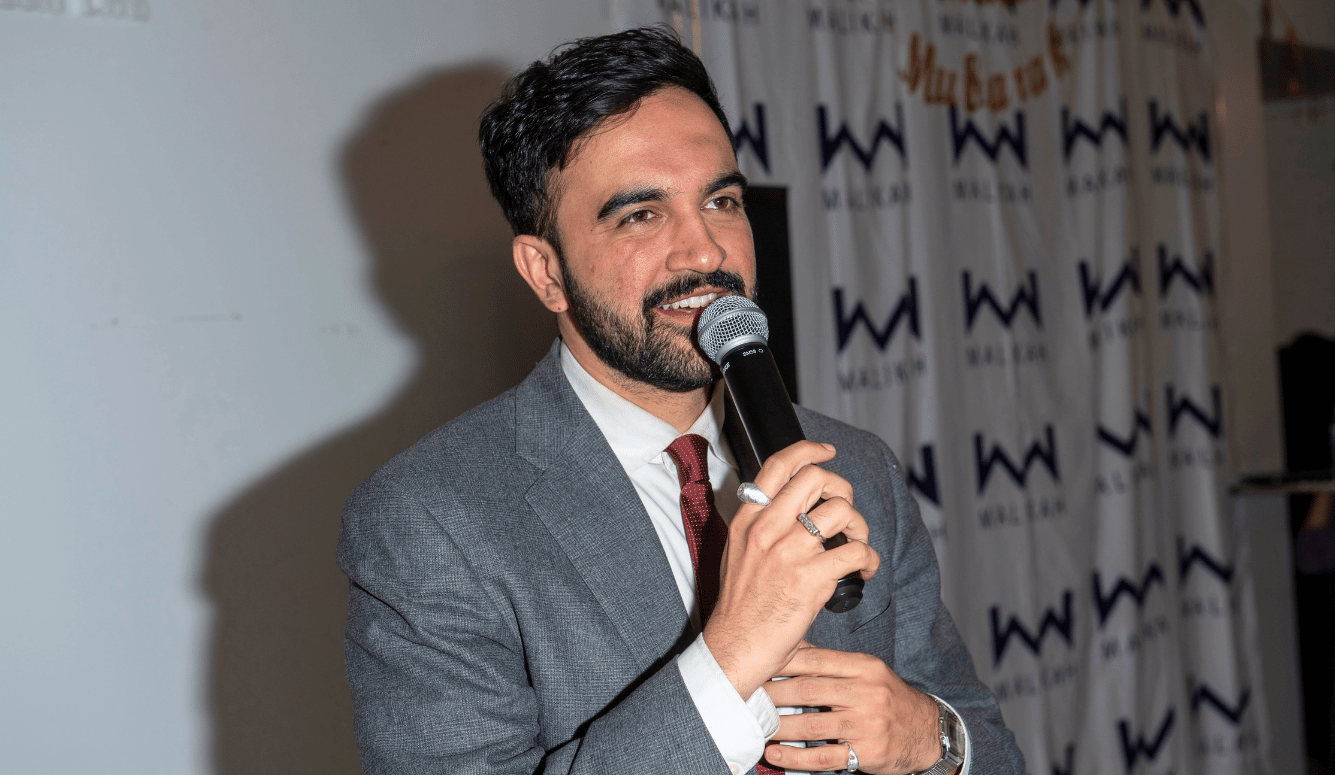
Zohran Mamdani is a 33-year-old New York State Assembly member from Astoria, Queens (Assembly District 36), the son of the academic Mahmood Mamdani and the movie director Mira Nair. Following a short-lived career as a rap musician, he emerged as a leading candidate in New York City’s Democratic mayoral primary in 2025, running as a Democratic Socialist with a sweepingly left-wing platform. Mamdani’s campaign focused on economic policies: he vowed to freeze rents, establish city-run grocery stores, expand free childcare and transit, push a US$30 minimum wage, and replace traditional policing with a “Department of Community Safety.”
Mamdani quickly garnered support from prominent progressive figures and organisations. Senator Bernie Sanders endorsed him with the explicit aim of blocking former Governor Andrew Cuomo’s comeback bid. Cuomo, who entered the mayoral race following his 2021 resignation as governor, is Mamdani’s chief rival. Mamdani was also backed by the Democratic Socialists of America and allied leftist groups; US Rep. Alexandria Ocasio-Cortez also lent him her support. Meanwhile, the Democratic establishment coalesced behind Cuomo: Michael Bloomberg endorsed the ex-governor, as did many labour unions and centrist Democrats.
On 24 June, Mamdani shocked political commentators by finishing first in the primary, ahead of a crowded field, winning roughly 43.5 percent of first-choice votes, while Cuomo trailed at about 36 percent. Cuomo conceded on election night, as soon as the votes had been counted. The result was a political earthquake: Mamdani, a second-term assemblyman from Queens, had defeated a former governor and scion of a New York political dynasty. He is now the Democratic nominee for mayor, making him the overwhelming favourite to win the mayoral election in deep-blue New York City.
Cuomo’s main line of attack against Mamdani was the latter’s criticisms of Israel, and his public defence of the slogan “Globalise the Intifada.” In a podcast interview with The Bulwark’s Tim Miller, Mamdani was pressed on whether chants like “Globalise the Intifada” and “From the River to the Sea” made him uncomfortable. Mamdani’s response was unapologetic. “To me, ultimately, what I hear in [that slogan] is a desperate desire for equality and equal rights in standing up for Palestinian human rights,” Mamdani said. He argued that “intifada” in Arabic means uprising or shaking off and pointed out that even the US Holocaust Memorial Museum uses the word intifada in an Arabic translation of an article about the Warsaw Ghetto Uprising. In other words, Mamdani tried to recast a phrase associated with violence against civilians in a benign light, as a call for justice and resistance to oppression. So, instead of debating housing, or transit, or policing, the media has been busy discussing Mamdani’s views on Israel and Palestine. Such is the age we live in.
Despite his working-class rhetoric, according to the New York Times, Mamdani is thirteen points ahead of Cuomo in New York’s richest districts, and the same number of points behind in its poorest ones. Mamdani racked up huge leads in what Michael Lange has dubbed New York’s “Commie Corridor”—a stretch of neighbourhoods filled with young professionals with progressive leanings—which begins in Mamdani’s Astoria district and runs south along the East River through gentrified parts of Brooklyn like Greenpoint, Williamsburg, and Bushwick.
Socialism was once the battle cry of factory workers and coal miners. Today, it’s increasingly the pet ideology of upper-middle-class urbanites sipping fair trade soy lattes and chanting of their wish to globalise an intifada that they know little or nothing about.
This is the gentrification of socialism. Of course, the most influential socialist of all time—Karl Marx—was no labourer. He was an upper-class dilettante, who spent his time abstractly theorising, not building or manufacturing anything. But the overall movement that he influenced has drifted away from a genuinely gritty history of battles against corporate bosses and become a fashionable accessory among society’s upper tiers with their cushy lifestyles. The slogan “Workers of the World, Unite!” is now often spouted by people who have never joined a trade union, swung a hammer, or missed a meal. It’s easier to champion a theoretical programme of radical redistribution when you’re a well-paid academic, a social media influencer, or a tech millionaire dabbling in socialism for its aesthetics. For these folks, socialism is a statement, a virtue signal. They wear their left-wing ideals like a designer accessory—for them it is what Rob Henderson has called a “luxury belief” to complement their luxury goods.
By contrast, Andrew Cuomo’s base in the primary looked much more like the classic Democratic machine coalition: older and more blue-collar. Cuomo did best in areas with large populations of black, Orthodox Jewish, Hispanic Catholic, and working-class voters. For instance, the Cuomo vote was strong in parts of the Bronx and Staten Island, which are more socially conservative and working-class. He won big in the Orthodox Jewish enclave of Borough Park, Brooklyn, where Mamdani’s stance on Israel is seen as toxic. In Southeast Queens, in and around Jamaica Bay, in an area with a large African-American population, Cuomo led among older black voters.

 | A guest post by
|