

German Democracy’s Uncertain Future
Friedrich Merz must take the concerns of ordinary citizens seriously—particularly on immigration and Islam. He must prove that such concerns can be addressed without veering into extremism.


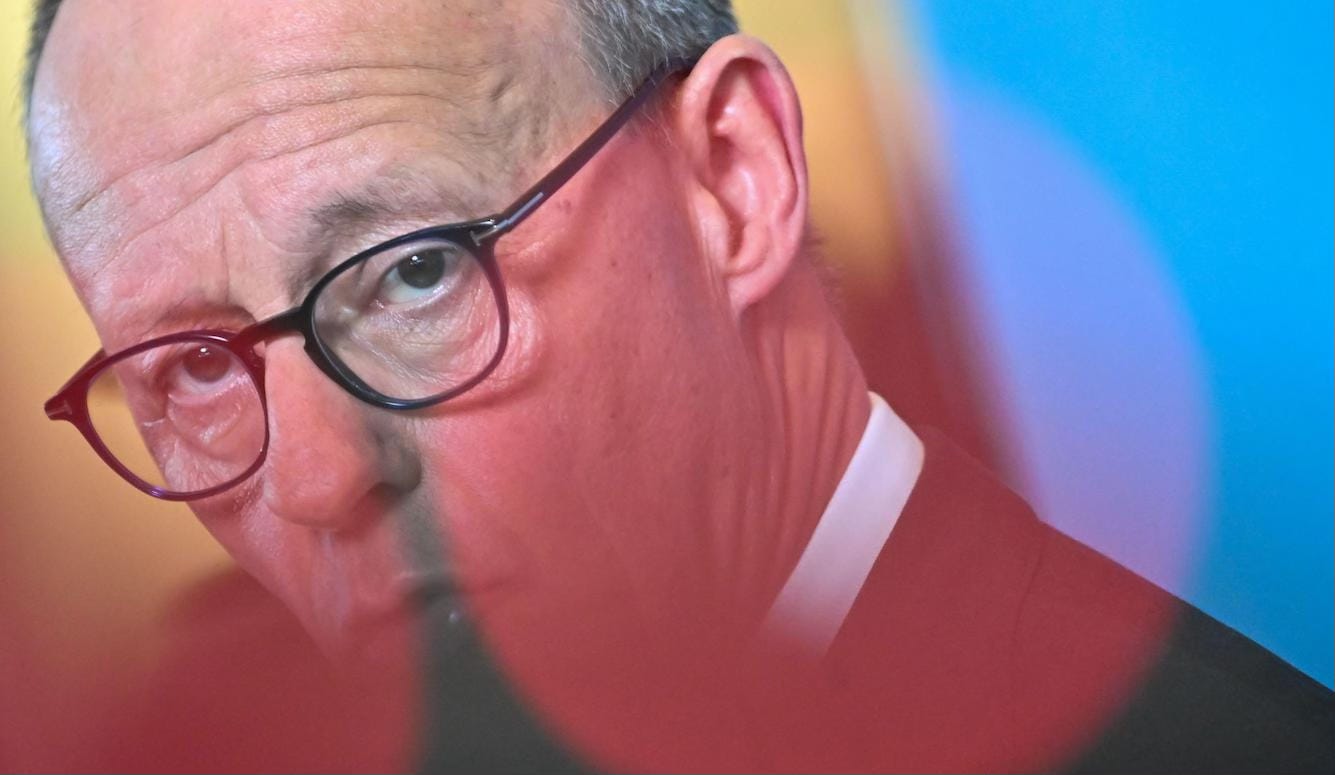
While undeniably historic, the results of Germany’s recent general elections were hardly unexpected. For months, polls forecasted major gains for the Alternative for Germany (AfD) party and steep losses for Chancellor Olaf Scholz’s Social Democrats (SPD), while Chancellor-elect Friedrich Merz’s Christian Democratic Union (CDU) maintained a comfortable lead. Since Merz has firmly ruled out a coalition with the nationalist AfD and has other options to form a majority government, the political centre appears to be holding—but for how long?
Many outside observers have described Merz’s exclusion of the AfD—which doubled its voter share from 10.4 percent in 2021 to 20.8 percent—as undemocratic. Writer and activist Ayaan Hirsi Ali, for instance, posted on X: “Why won’t the CDU respect the mandate given to the AfD by millions of Germans and form a majority government with them?” The short answer is that as the strongest party, the CDU must build a stable coalition with one or more parliamentary parties with which it shares common ground. The AfD, which includes confirmed extremists, has not positioned itself as one of them. Voices like Hirsi Ali’s fail to distinguish between the importance of addressing pressing issues that have been neglected and supporting a populist political party that exploits them to gain power for itself.
Germany has serious problems with Islamism as a consequence of failed multiculturalist immigration policies. A series of fatal jihadist stabbings and car rammings, which escalated in the lead-up to the elections, has deeply shaken the country in recent years. In hindsight, former Chancellor Angela Merkel’s response to the 2015 refugee crisis, “Wir schaffen das” (“We can do it”), sounds almost cynical. Unsurprisingly, internal security and immigration were key issues driving voters, who turned out in force—82.5 percent of eligible voters went to the polls, the highest turnout for a general election since 1987.
In addition to the frequent terrorist attacks, the blatant displays of antisemitism and open calls for a caliphate among immigrants following Hamas’s atrocities against Israeli civilians on 7 October 2023 forced German officials to confront past failures and adopt a tougher stance on Islamism. This was imperative, given Germany’s special relationship with Israel and the Jewish people in light of the Nazi Holocaust. Many mainstream politicians vowed to curb immigration and crack down on Islamist activity. But by the time they did so, the AfD had already monopolised the issue and was steadily gaining ground—first in Eastern Germany, then nationwide.
Acute awareness of Germany’s Nazi past has also made many deeply wary of the AfD’s rise—for good reason. Björn Höcke, a leading figure in the party’s influential ethnonationalist wing and head of its Thuringia chapter, has called for “nothing less than a 180-degree shift in our remembrance culture” regarding the Nazi era, and has promoted crude racial theories. “Evolution has given Africa and Europe two distinct reproductive strategies,” Höcke argues. While Africans prioritise maximum population growth, Europeans, he claims, adapt to the carrying capacity of their environment. Höcke, who has been fined for using the Nazi slogan “Alles für Deutschland” (“Everything for Germany”), further asserts, “As long as we are willing to take in [Africa’s] surplus population, there will be no change in the reproductive behaviour of Africans.”
Having failed to oust Höcke for damaging the party’s image, on election night AfD frontrunner Alice Weidel celebrated alongside the court-confirmed fascist—“a true National Socialist,” as former party spokesperson Frauke Petry has called him. Weidel raised further concerns by delivering a blistering speech at a recent party convention in which she endorsed forced mass “remigration,” a concept linked to the ethnonationalist Identitarian movement. It is little wonder that some 80 percent of German voters rejected the AfD. Many did so out of concern for their country’s democratic future—a sentiment that fuelled mass protests across Germany ahead of the elections—200,000 people joined the rally in Munich alone—and likely contributed to the high voter turnout.
Elon Musk, whose endorsement of the AfD appears to have had little impact on German voters if polls are to be believed, fundamentally misread this sentiment when he claimed that “too much focus on past guilt” prevents Germans from looking forward. Likewise, Sky News host James Macpherson’s assertion that the AfD’s electoral gains prove that “Germans simply want their country back” ignores the broader context. The vast majority of Germans have no desire to see the AfD anywhere near the levers of power.
But Germany is a deeply divided society. The fact that the federal states where the AfD secured a staggering 32 percent of the vote align perfectly with the former German Democratic Republic (GDR)—except for East Berlin, where only one district went to the AfD—speaks volumes. Thirty-five years after reunification, Eastern Germany still lags behind the West socioeconomically, with 14 percent lower wages. Frustrated by what they see as Western democracy’s failure to deliver prosperity, many in the East place their hopes in what they perceive as a viable alternative.
The East–West divide, however, runs deeper than socioeconomics. Four decades of authoritarian communism have left a lasting imprint. The GDR regime portrayed itself as inherently anti-fascist, depicting the liberal capitalist West as the true successor to Nazi Germany—effectively absolving its own citizens of historical responsibility.
➜ Read the full article at Quillette.com
Note: Quillette maintains its independence through reader subscriptions. You'll need a subscription to access the complete article.
 | A guest post by
|