

How Doctors Without Borders Became a Political Actor in Gaza
In recent years, large international NGOs have increasingly blurred the line between humanitarian work and political advocacy By Gerald M. Steinberg, E. Levenson and Zoe Booth
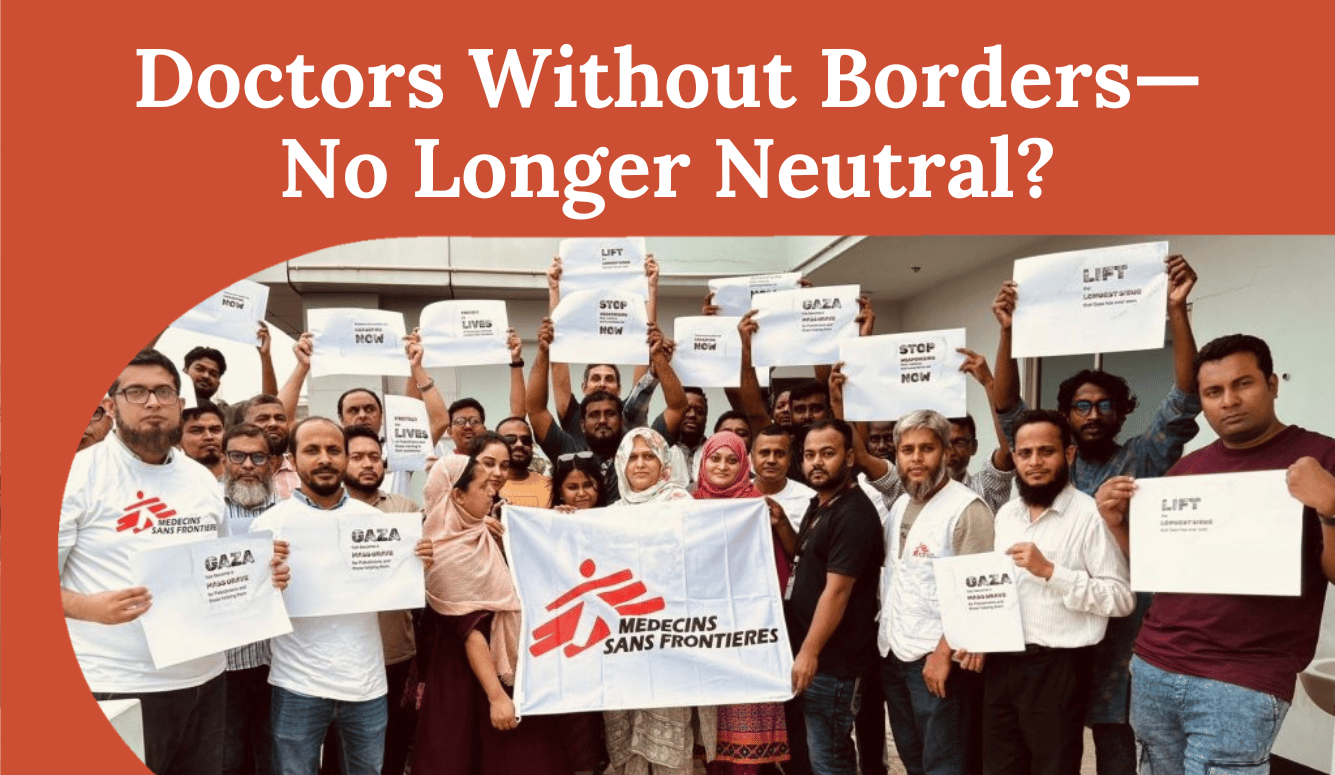
For decades, Médecins Sans Frontières (MSF), also known as Doctors Without Borders, was regarded as one of the world’s most trusted humanitarian organisations. Its authority rested on a strict commitment to medical neutrality—the principle that humanitarian medicine must remain independent of political causes, even in war. Awarded the Nobel Peace Prize in 1999, MSF became synonymous with ethical restraint and institutional credibility.
That reputation is now under serious strain.
This video examines how MSF’s response to the war in Gaza reflects a marked departure from its long-standing principles. It analyses the organisation’s adoption of activist language, including public accusations of genocide against Israel, while remaining conspicuously silent on Hamas’s documented war crimes, including the October 7 massacre and the systematic use of civilian infrastructure for military purposes.
Central to this breakdown is the role of Ghassan Abu-Sittah, a British-Palestinian surgeon associated with MSF whose public claims following the al-Ahli Hospital explosion helped fuel global outrage based on allegations later shown to be false. Despite mounting evidence that the blast was caused by a misfired Palestinian rocket, MSF neither corrected the record nor reconsidered its reliance on Abu-Sittah as a neutral authority.
Drawing on the reporting and analysis of Gerald M. Steinberg and E. Levenson, this video explores how humanitarian legitimacy can be repurposed for political advocacy—and why the erosion of medical neutrality carries serious moral and institutional consequences.
Chapters
00:00 Doctors Without Borders, medical neutrality, and the rise of MSF’s global reputation
01:08 MSF’s genocide accusations against Israel and the adoption of political messaging
02:33 Ghassan Abu-Sittah, the al-Ahli Hospital explosion, and the spread of false narratives
06:10 Internal dissent within MSF and the shift from humanitarian relief to advocacy
08:12 Ethical consequences of silence on Hamas and the collapse of medical neutrality
Full transcript
For decades, Médecins Sans Frontières—Doctors Without Borders—was treated almost like a secular saint in global affairs. Neutral, heroic, fearless. Its doctors operated on the front lines of civil wars, outbreaks, natural disasters. In 1999, it was awarded the Nobel Peace Prize, lauded for its medical ethics and unimpeachable neutrality. According to its own charter, MSF was supposed to rise above politics, guided only by the Hippocratic oath and humanitarian values. But as the dust begins to settle over Gaza and the conversation shifts toward reconstruction and accountability, one thing has become increasingly clear: MSF has abandoned the very principles that made it so revered. Instead of remaining a neutral provider of care, it has turned medicine into yet another theatre of ideological warfare—and has done so under the guise of humanitarianism.
