


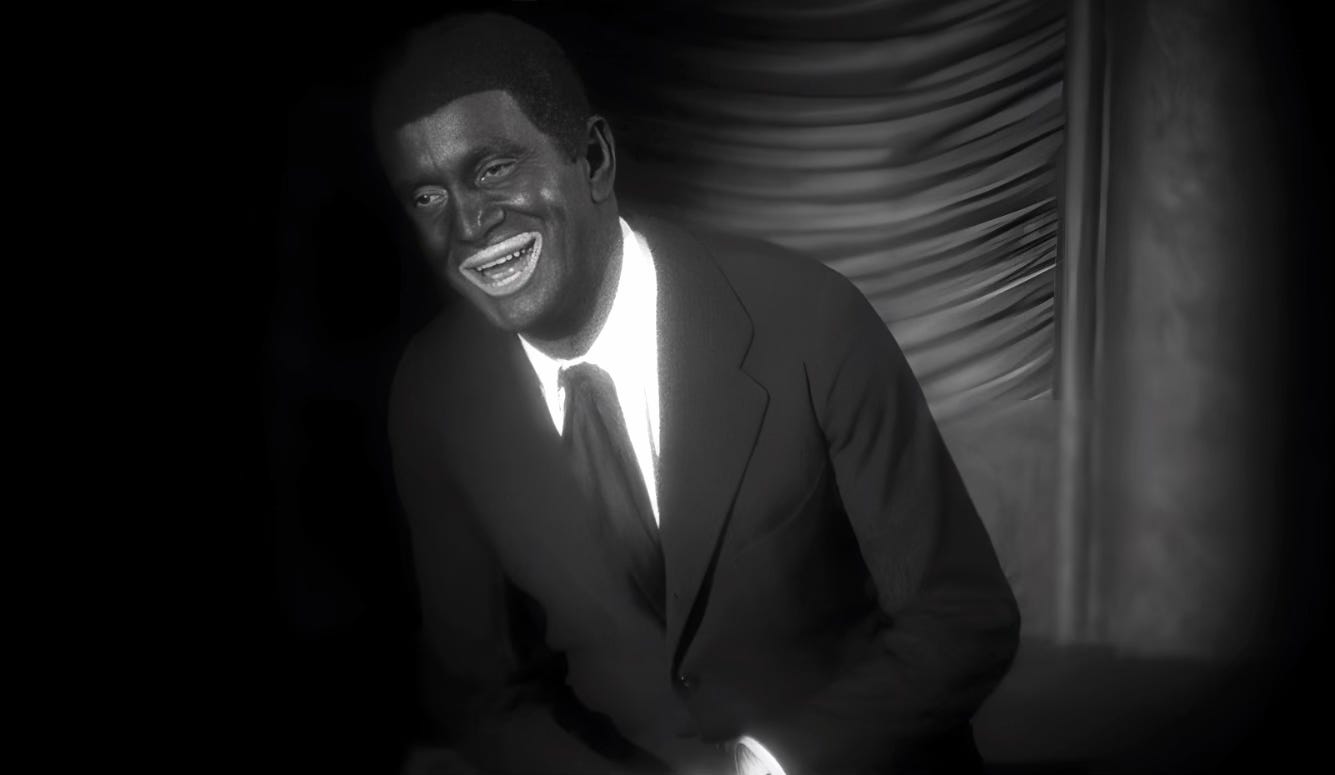
A review of Only in America: Al Jolson and The Jazz Singer by Richard Bernstein, 252 pages (Alfred A. Knopf, 2024)
Shortly after sunset on the evening of 6 October 1927, 1,400 people converged on the Warner theatre in Manhattan to watch history being made. At first, the motion picture being projected seemed fairly ordinary—a run-of-the-mill family melodrama, performed in silent pantomime, just like every other feature film before it. All that changed fourteen minutes into the show when the protagonist suddenly burst into song. The lyrics were not carried in title cards but by a merry, fluting tenor audible to everyone in attendance. “Wait a minute, wait a minute,” he chirped when the song was done. “You ain’t heard nothin’ yet.”
That line was delivered in character, but it could also have been addressed directly to the audience, who immediately began hooting and cheering. “It was one of those once-in-a-lifetime experiences,” the film director Frank Capra recalled. “A vision ... a voice that came out of a shadow.” By the time the film was over, the crowd were cheering and stamping their feet until the star walked down the aisle to bask in their applause. Film producer Walter Wanger ran to the phone to call his boss Jesse Lasky in California. “Jesse,” he cried, “this is a revolution!” The era of talking pictures had arrived.
The film shown that night was, of course, The Jazz Singer, and its star was the great vaudeville performer Al Jolson. For decades, filmmakers had tried (and failed) to make movies talk. The stumbling block was synchronisation. Even Thomas Edison, inventor of the phonograph and the motion-picture camera, couldn’t get his gizmos to harmonise for more than a few minutes at a time.
In 1924, the engineers at Western Electric finally licked the problem... sort of. That May, they unveiled their newest invention, an unwieldy contraption the size of a Bugatti engine that yoked a turntable to a movie projector. It wasn’t pretty to look at, but it did what no one had been able to do before: marry sounds and images. Unfortunately, it was a nightmare to operate. Though The Jazz Singer was only 89 minutes long, its soundtrack consumed fifteen discs, each of which had to be synced to a corresponding reel of film. Had the projectionist failed to cue up a disc at precisely the right moment, the premiere might have been a disaster.
Curiously, in his new book Only in America: Al Jolson and The Jazz Singer, Richard Bernstein devotes just two short paragraphs to this epochal event, though he does mention that tickets cost a whopping five US dollars. (For that amount of money, a person could have bought a three-course dinner at Delmonico’s, the swanky New York restaurant frequented by F. Scott Fitzgerald.) Nor does Bernstein spend much time on the technical wizardry of the film, which felt as uncanny to people in the 1920s as artificial intelligence feels to us today. Bernstein dwells instead on the racial politics of The Jazz Singer—a focus that will, no doubt, make some readers groan.
If there’s one thing our public discourse hasn’t been short of lately, it is discussions about racial identity, often conducted by hucksters like Robin DiAngelo and Ibram X. Kendi, who perpetuate the very bigotry they claim to abhor. I am happy to report, however, this isn’t that kind of book, Bernstein isn’t that kind of author, and in the case of The Jazz Singer, the discussion is merited and thoughtful. As John Strausbaugh pointed out in his superb 2006 book Black Like You, “The Jazz Singer is at least as remarkable for the story it tells as for the technical revolution it signaled. ... [Its] story is nothing less than a microcosm of the entire American project: the creation of an American Culture out of the disparate elements of many ethnic and racial subgroups.”
Which isn’t to say the story is good, exactly. The plot is pure schmaltz. The protagonist, a Jewish boy named Jakie Rabinowitz (Jolson), yearns to be a jazz singer, much to the consternation of his father (Warner Oland), a fifth-generation cantor who demands that Jakie follow in his footsteps. One day, the old man catches his son singing in a saloon. They fight, Jakie runs away, and when we meet him again, he’s a grown man working as a nightclub singer under the stage name Jack Robin. Though he hasn’t spoken to his father in years, he’s stayed in touch with his mother (Eugenie Besserer), who cherishes every one of his letters home.
➜ Read the full article at Quillette.com
Note: Quillette maintains its independence through reader subscriptions. You'll need a subscription to access the complete article.