

Memorial Daze
By George Case.

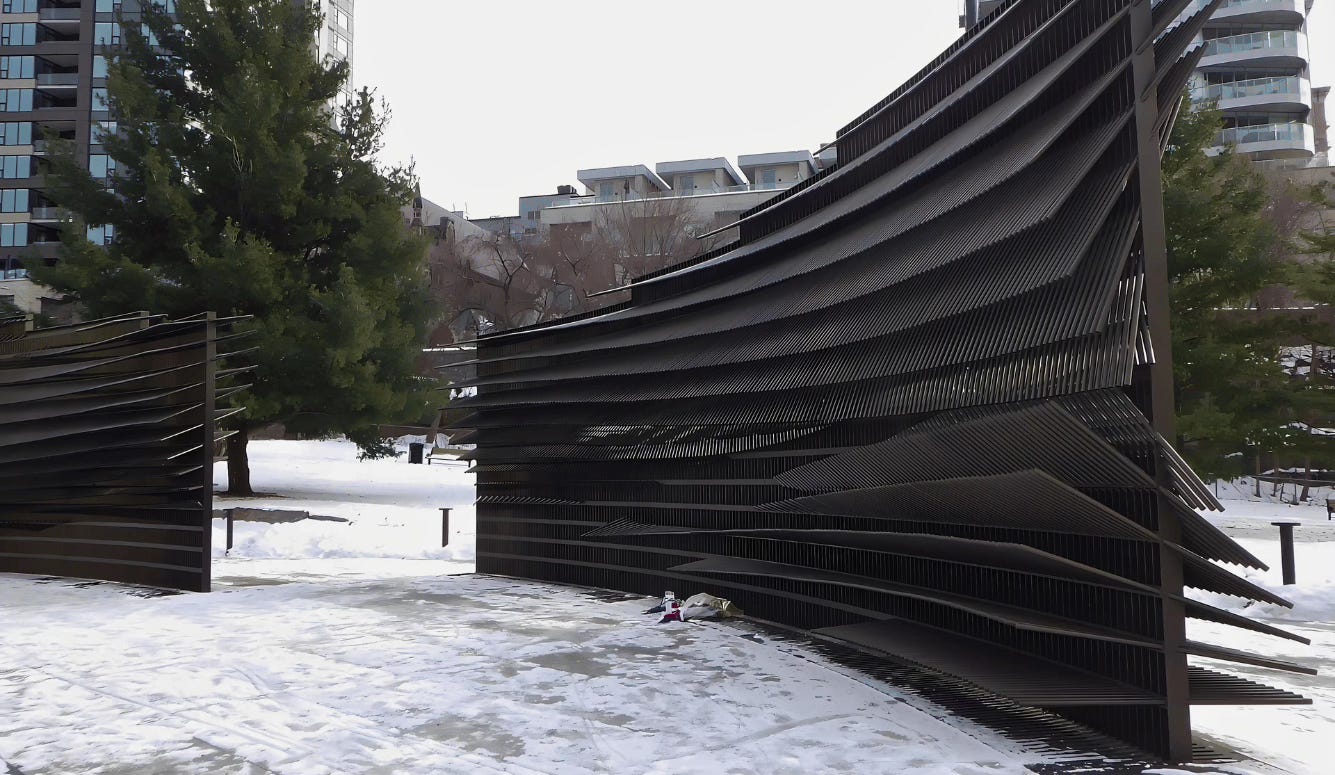
After many delays, Canada’s Memorial to the Victims of Communism was officially opened at Wellington and Bay Streets in the nation’s capital on 12 December 2024. The memorial was originally meant to include a display of names honouring individuals who had fought against Soviet oppression, but it attracted controversy and protests when it emerged that some of the honourees might have fought for the Nazis during the Second World War. “At the time of the unveiling, there will be no names on the monument’s wall,” a spokesman for the Ministry of Canadian Heritage equivocated.
Like many other countries, Canada is home to a number of public buildings, plaques, and shrines marking tragic episodes from history. Of course, war memorials in big cities and small towns have long commemorated soldiers, sailors, and airmen who fought and died in armed conflicts, but a crop of newer structures have arisen to recognise not warriors but victims. There’s a National Holocaust Monument in Ottawa and Holocaust museums in Toronto and Montreal; a Nikkei Internment Memorial Centre in British Columbia remembers the citizens of Japanese origin forcibly relocated during World War II; a Residential School Memorial in Saskatchewan preserves the memory of vulnerable Native children sent to state- or church-run institutions; the Africville National Historic Site in Halifax, Nova Scotia pays tribute to the province’s community of escaped American slaves and their descendants; and a planned “2SLGBTQ+” memorial in Ottawa will mark the career-ending discrimination once faced by Canada’s gay civil servants, military personnel, and others. The imposing Canadian Museum for Human Rights in Winnipeg, Manitoba incorporates all these histories and more under a single, environmentally sustainable roof.
The Memorial to the Victims of Communism was first proposed by an earlier national government in consultation with Tribute to Liberty, a private group that includes Ukrainian, Polish, Korean, Latvian, and Vietnamese Canadian members. They no doubt looked to international examples for inspiration, such as the Victims of Communism Museum in Washington DC, and other cenotaphs in Eastern Europe. More compelling, obviously, was the evidence of communist atrocities that finally became irrefutable upon the collapse of the Soviet Union and its satellite regimes. These crimes were catalogued in works like 1997’s essay collection The Black Book of Communism and 1986’s Harvest of Sorrow: Soviet Collectivization and the Terror-Famine by Robert Conquest, which opened with the grim sentence, “[I]n the actions here recorded about twenty human lives were lost for, not every word, but every letter, in this book.”
But like others before them, the sponsors of Canada’s Memorial to the Victims of Communism have found that history is messy. Just as statues of long-dead prime ministers have been re-evaluated—and, in some places, dismantled—when the achievements they celebrate come under present-day critical scrutiny, so various local commemorations of victimhood are now subject to similar consideration. There is certainly widespread consensus that communist policies during the 20th century led to the deaths of tens of millions under Stalin, Mao, Pol Pot, and their emulators: people starved on farms, were executed in prisons, massacred in killing fields, and left to die in gulags. Surely their suffering, and the courage of those who resisted, should never be forgotten? The problem is that some of these men and women resisted communism in the name of an ideology that was itself culpable in a separate swath of brutality that tallied up its own hecatombs.
➜ Read the full article at Quillette.com
Note: Quillette maintains its independence through reader subscriptions. You'll need a subscription to access the complete article.