

Picture Perfect
By Andrew White

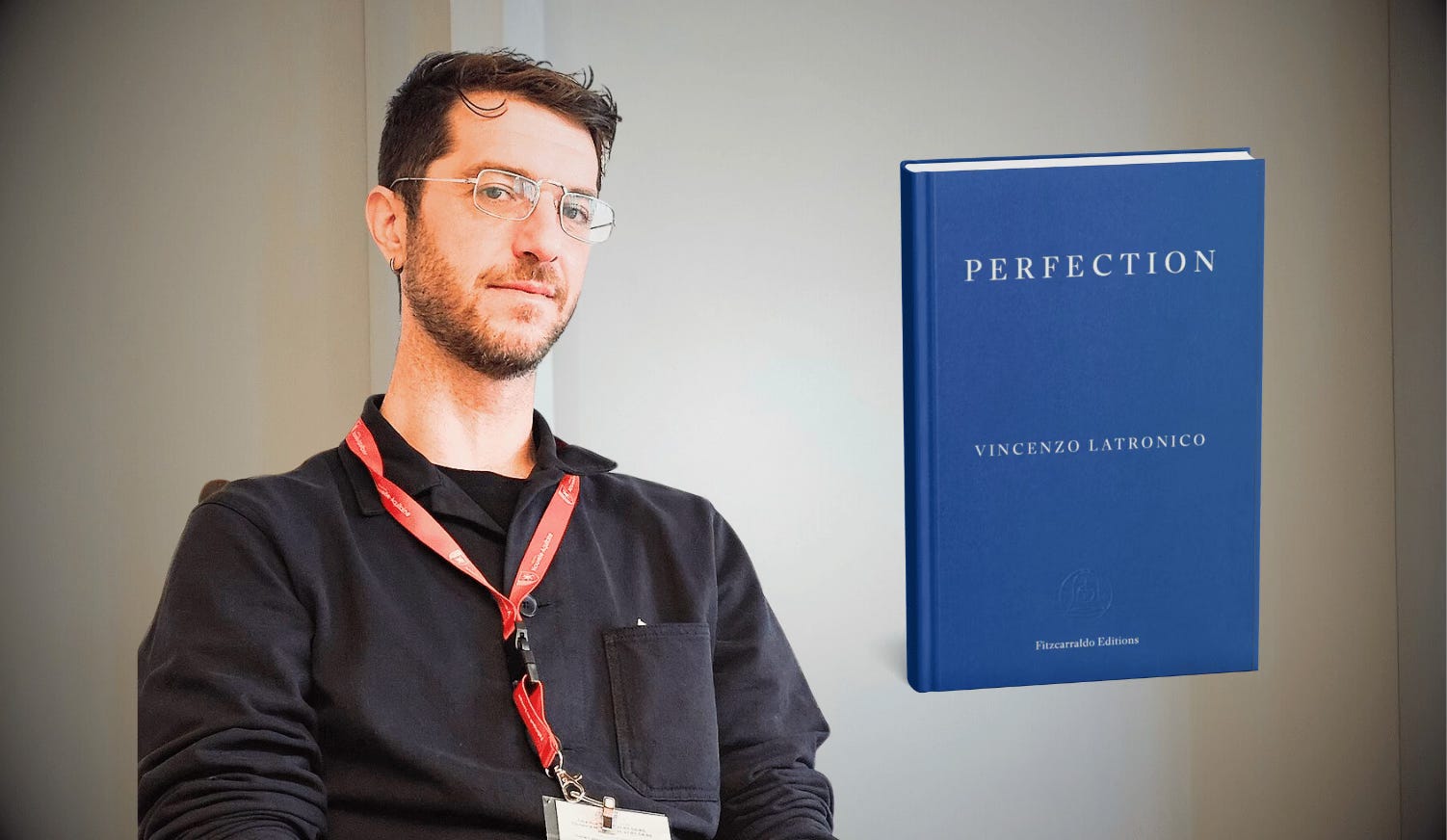
A review of Perfection by Vincenzo Latronico, 120 pages, Fitzcarraldo Editions (February 2025)
That was where real life was, the life they wanted
to know, that they wanted to lead.
~Georges Perec, Things: A Story of the Sixties
Unbounded—that was the strange word bubbling up as I wandered Helmut Newton’s exhibition on a Berlin summer morning in 2019. It was only my fifth day in the city and already the relief of having arrived, and the giddiness for what lay ahead, was beginning to drain into a slowly dilating void. Looking at the naked decadence of those maximalist and oversized photographs, I couldn’t help but feel hopelessly depressed by it all. There was something reflected in these images; something about this performed, preening hedonism that was mesmerising but also meaningless. The exhibition seemed to prefigure our current, life-draining obsession—one that seeks to frame each moment as an image to be captured and then collaged into a performed version of ourselves. The more our reality is unbound into tiles and tweets and TikTok clips—the more we live within a curated version of life—the more our own sense of what is real and authentic becomes concealed.
This moment resurfaced while reading Vincenzo Latronico’s novel, Perfection. Translated into English by Sophie Hughes at the beginning of this year, Perfection traces the lives of Tom and Anna, “creative professionals” living in Berlin during the 2010s. It is a reworking of Georges Perec’s novella, Things: A Story of the Sixties, which documents a young Parisian couple defining their identity through beautiful objects and the alienation they feel as a result. For Tom and Anna, these “objects” are the images of social media, which increasingly govern their lives and split them from their own sense of what is real and essential.
Not long out of university, Tom and Anna move to Berlin on a whim. Their days are spent working from home in an apartment that might have featured in a 2014 issue of Kinfolk Magazine. The novel’s opening describes sunlight reflecting off “honey-coloured floorboards,” the perforated leaves of a monstera brushing the back of a Scandinavian armchair half-covered in a “herringbone tweed” blanket. Back issues of Monocle and the New Yorker are propped against carefully curated homewares, an LP collection faces outward, and everything is tied together perfectly with a “sandy-coloured Berber rug.” It is “a happy life” we are told—or so the images suggest on the short-term rental website listing their home for “one hundred and eighteen euros a day.”
Tom and Anna’s life is dictated by images—a life in which the messiness of reality sits just outside the camera’s lens. Their work consists of building wireframes, choosing fonts, and tweaking margins for the galleries, kombucha breweries, vegan food companies, and other experience economy brands emerging at the time. We never find out much about their past, except that they are from a provincial city somewhere near the Mediterranean. “Lovers, partners and best friends,” they are only spoken of together in the novel and described as having, “grown up with the notion that individuality manifested itself as a set of visual differences.” It is this notion that motivates them in their work, that pushes them to Berlin and that drives the curation of their lives.
Their move to Berlin is part of a shared struggle with “an entire sector of their generation” for a different life, for the freedom to reinvent themselves. They spend much of their first year in the city constructing a life that matches the shared mythology of transformation for which everyone else seems to be searching. Simply being in Berlin feels like enough to them: it is Berlin that is their purpose, defining them more than their work. It is the “quasi-reality” of this mythology that becomes the canvas they sketch their identity on—a canvas stretched and framed by a feeling of abundant possibility.
Reading this novel, I was reminded of Gideon Lewis-Krauss’s 2012 memoir of Millennial restlessness, A Sense of Direction. Writing about his life in Berlin around the same time that Tom and Anna arrive, he described the city as having an air “clear with vast possibility,” a haven for a “rumoured lost generation” seemingly marooned “on an island outside of time.” Everyone Lewis-Krauss meets seems to hold an almost religious belief in personal reinvention—a belief he shares as he reflects on his own “grand gesture” of faith in the city and his assumption that simply being there would allow a more authentic existence to reveal itself.
Writing of his naivety in hindsight, Lewis-Krauss quotes a line from the 1920s critic and gossip columnist, Karl Scheffler, who quipped that Berlin was damned always to become and never to be. Initially, he is seduced by this notion of becoming, thrilled at not needing to worry about missing the right moment or frittering away time doing not much—he is completely unbound from any demands or responsibilities. He recognises later (as do Tom and Anna) that the shadow of all that possibility is an open-endedness that is intense and exciting, but also chaotic and draining. Possibility without purpose leads to nihilism, and it is only later, as he reflects on Scheffler’s quote, that he realises he missed the word damned.
It is this constant becoming that flicks sparks of anxiety onto the surface of Tom and Anna’s perfect life. As the energy of the city ebbs, they begin to feel as though their “identity was anchored not in their thoughts or deeds, but in something fickle and brittle, a roll of the dice.” Seeing what now seem like the distant lives of their friends and family on Facebook, their own images of Berlin begin to degenerate, and they realise how radicalised they’ve become in their expat bubble. A bubble “where everyone accepted a line of coke, where no one was a doctor or a baker or a taxi driver or a middle school teacher,” a bubble where they feel increasingly alienated. Despite this, they are unable to imagine any other reality and so convince themselves that no other reality exists.