



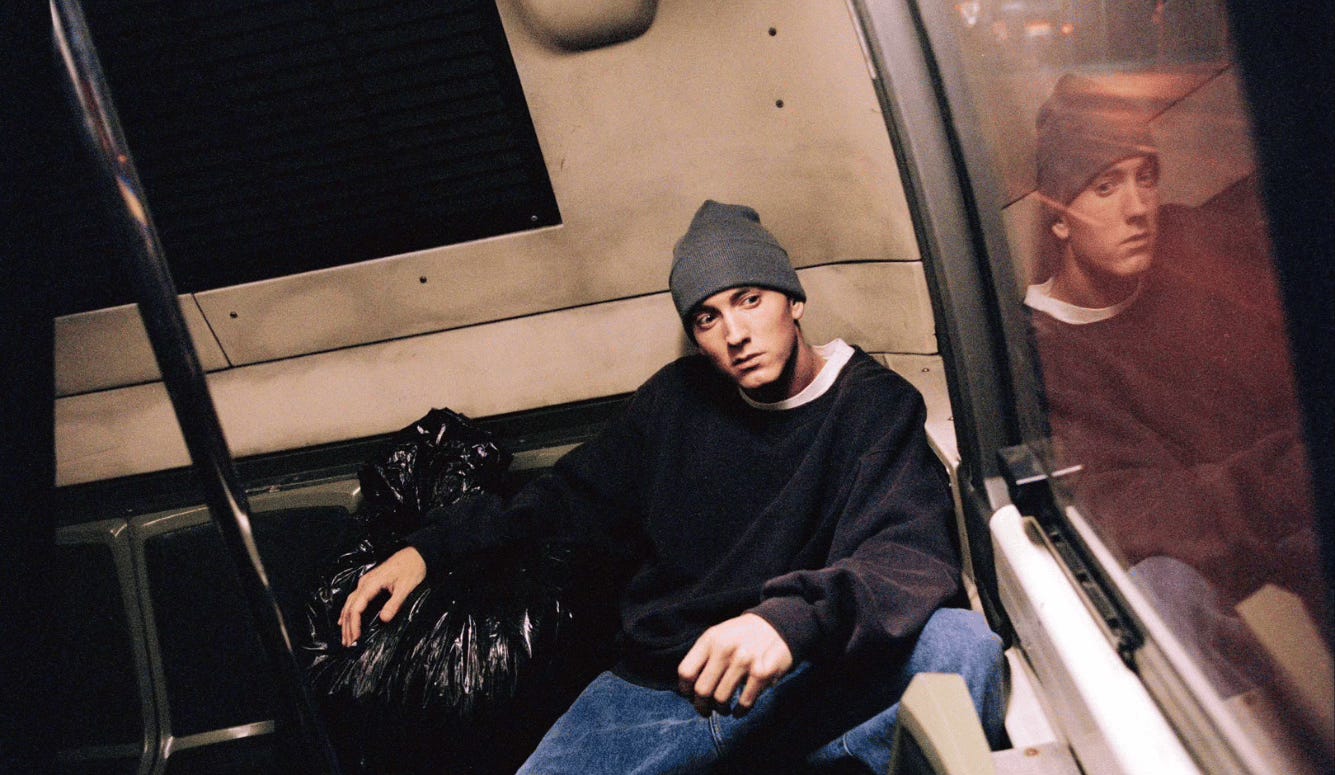
Before American musician Marshall Mathers made a name for himself as the global cultural sensation Eminem, he was already a gifted lyricist and wordsmith on the Detroit underground scene. “I’ve been writing lyrics since I was like fourteen years old,” he explained at a press conference some years ago, “and just the more I wrote the better I kept getting at it.” His lyrics are sometimes outrageous, but they can just as often be thoughtful and introspective. This made Mathers a somewhat unusual figure on the notoriously macho American hip-hop scene and helped him reach an audience beyond the genre’s traditional fan base. As he explained in his 2008 memoir, The Way I Am: “I’m not alone in feeling the way I feel. I believe that a lot of people can relate to my shit—whether white, black, it doesn’t matter. Everybody has been through some shit, whether it’s drastic or not so drastic. Everybody gets to the point of ‘I don’t give a fuck.’”
Consider the lesser-known track “If I Had” from his second studio album, The Slim Shady LP in 1999—the record that really established his voice and introduced the world to his alter-ego, Slim Shady. It’s a tragic song about failure, poverty, and broken selfhood that opens with a self-penned poem about life, the world, and other people. It begins like this:
What is life?
Life is like a big obstacle in front of your optical to slow you down,
And every time you think you’ve gotten past it,
It’s gonna come back around to tackle you to the damn ground.
Life—those opening lines seem to say—is suffering. The introduction offers disenchantment on the subject of friends (“Friends are people that you think are your friends”) and money (“Money is what makes a man act funny”) before Mathers launches into the first verse and the track becomes a litany of daly frustrations, starting with “I’m tired of backstabbin’-ass snakes with friendly grins.” The song apparently emerged from a particularly unfortunate week in 1997, back when Mathers was still broke and struggling. “My fuckin’ engine blew out and a bunch of fucked up shit was all happening at the same time,” he later recalled in his 2000 memoir, Angry Blonde. The song begins by punching outwards, but there are moments of self-criticism, too—“I’m tired of committin’ so many sins…” By the time the track ends, we have been treated to an unforgiving portrait of despair.
Mathers had his own fair share of reasons to feel aggrieved. His childhood in post-industrial Detroit was poor and unstable. His father walked out when he was only six months old, and he was raised by his erratic and overbearing mother. He was moved from place to place and from one school to another, where he was often the only white kid. All this dislocation contributed to Mathers’s sense that he didn’t really belong anywhere at all. As a small and skinny boy, he was a frequent target of bullying, an experience he referenced in the song “Brain Damage” from the same album, which is about a childhood assault that left him in a coma for five days.
Mathers felt as though his masculinity was under siege. His uncle Ronny introduced him to the Beastie Boys at an early age, which gave him a sense of creative possibility. But when Ronny committed suicide, Mathers lost the only father figure in his life. He began participating in local rap battles using the name Eminem, and his precocious talent soon drew the attention of Detroit producers Mark and Jeff Bass, who helped him record his debut studio album Infinite in 1996. The album was a commercial failure and received mixed reviews. With his personal life in disarray and his creative fortunes looking bleak, Mathers reportedly attempted suicide. But by 1997, he had regrouped and recorded The Slim Shady EP, which led to an approach from Interscope Records. There, he was introduced to NWA’s former producer (and occasional emcee) Dr. Dre, who offered to helm Mathers’s next album. It was the break he had been waiting for.
Released in 1999, The Slim Shady LP distilled all the unhappiness, rage, and frustration Mathers had experienced into twenty tracks. “If I Had” was Eminem’s take on confessional blues, and each line seemed to correspond in its specificity to some broader feeling. “Tired of havin’ skinny friends hooked on crack and Mini Thins.” I’m tired of my sordid social environment. “I’m tired of this DJ playin’ your shit when he spins.” I’m tired of being overlooked and underappreciated. The lyrics bounce from the profound to the trivial, from the material to the spiritual, and from socio-political critique to darkly comic observation, and the songs’ thematic and linguistic diversity are complemented by the breathtaking flow. Eminem fantasises about what he would do with success if he found it, and his ideas range from the ridiculous (“If I had a million dollars, I’d buy a damn brewery and turn the planet into alcoholics”) to the profane (“If I had a magic wand, I’d make the world suck my dick without a condom on while I’m on the John”). The song ends with a defiant middle finger raised to the world and everyone in it: “If I had one wish, I would ask for a big enough ass for the whole world to kiss.”
The roots of hip-hop in African-American culture date back to the rhythmic songs sung by slaves in the antebellum era. As a versatile art form, it has evolved over time as technology has changed. Turntables, scratching, and samples were replaced by digital soundscapes, absorbing elements of rock and roll, disco, R’n’B, and dance music along the way. It has become a uniquely American pop-cultural form with many different waves and phases, from early New York City block parties in the ’70s to the new school and golden age of East Coast hip-hop in the mid-’80s (Run-DMC, LL Cool J) and the gangster rap of the late ’80s and early ’90s (Ice-T, NWA, Ice Cube, Biggie Smalls, Tupac, Wu-Tang Clan). The turn of the century was a time of transformation in pop culture and music, and Eminem caught the rap-rock wave that mixed rock, punk, and metal samples with hip-hop beats and lyrics. Def Jam Records’ founder and house producer Rick Rubin played a large part in the creation of this subgenre, particularly in his work on the Beastie Boys’ first album Licensed to Ill (1986) and Run-DMC’s smash-hit collaboration with Aerosmith, “Walk This Way,” the same year. But Eminem took the form and made it his own.
I was just a kid when Eminem hit his peak with The Marshall Mathers LP in 2000 and 2002’s The Eminem Show, which was the biggest album of the year in any genre. I was drawn by the unusual balance of absurdism and realism, which struck me as so personal that it was universal, and so horrible that it was funny. I had the sense that this tormented young artist was really feeling the things he was rapping about, even if the material itself was outlandish. Influenced by American rap and rock alike—from Erik B & Rakim to Jimi Hendrix—as well as films like The Truman Show (1998) and the horror genre, Eminem’s songs mixed pop-friendly guitar hooks with personal narratives that flipped between cartoonish lewdness and earnest sincerity. He wasn’t just a great lyricist, he was also an exciting performer who really sang his songs and imbued his words with soul. His music was more introspective and self-critical than most of the boastful gangster rap of the ’90s. He invited his listeners to see themselves with the same dark humorous objectivity with which he saw himself.
➜ Read the full article at Quillette.com
Note: Quillette maintains its independence through reader subscriptions. You'll need a subscription to access the complete article.
