


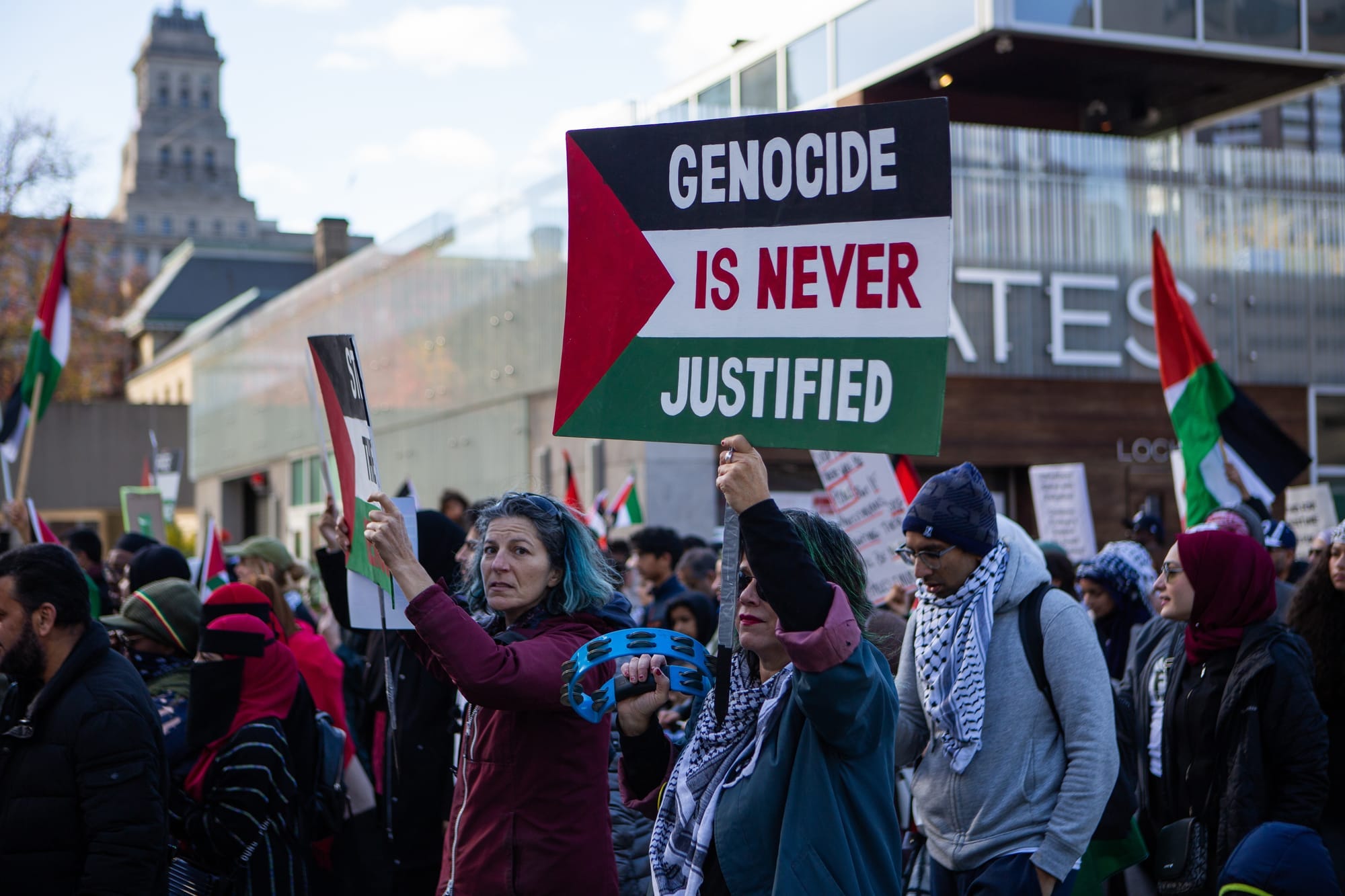
As the Gaza War approaches its second anniversary, the accusation that Israel is pursuing a policy of “genocide” against the Palestinians in the coastal enclave persists. The word has been employed by activists, commentators, human-rights organisations, and even officials of various governments, who characterise Israel’s military campaign and its strategic goals in the most sinister terms. The claim that the Israeli government and military (IDF) seek the destruction of a population is extremely serious, so it deserves careful and fair-minded consideration. With this in mind, a comprehensive new study by the Begin-Sadat Center for Strategic Studies (BESA Center) in Tel Aviv examines the factual record in an attempt to distinguish verifiable facts from politically motivated fiction. It concludes that the genocide accusations are unsupported.
The BESA study is written by a team of Israeli military historians and conflict researchers (Danny Orbach, Jonathan Boxman, Yagil Henkin, and Jonathan Braverman), and they approach the issue with academic thoroughness and a clear concern for truth. The authors emphasise that their aim is not to defend every Israeli action, nor to overlook the war’s terrible human cost, but to ensure that any discussion of legality or morality rests on an accurate foundation: “Our focus on factual analysis,” they write, “in no way diminishes or ignores the severe human suffering in Gaza.” By avoiding polemics and focusing on verifiable data, the BESA scholars present a compelling and persuasive counter-narrative to the genocide claim.
The stakes in this debate are high: the accusation of “genocide” is not merely a matter of semantics, it shapes international policy, public perception, and possibly even legal actions. It is therefore important to get the facts right.
I. Starvation
One of the earliest and most emotive accusations made during this conflict was the claim that Israel has imposed a starvation siege on Gaza. Images of emaciated children and warnings of famine spread rapidly in late 2023 and through 2024, as Gaza’s supplies of food, water, and electricity all came under pressure. A number of influential voices argued that Israel was deliberately depriving two million Gazans of basic necessities, effectively using hunger to kill the population or drive it out of the Strip. If true, this would be a heinous crime. However, the BESA study shows that the starvation story was based on incorrect data and an echo chamber of circular reporting, whereby NGOs and media outlets repeated each other’s alarming allegations without investigating the original data.
For instance, it was widely reported that, before the conflict, around 500 trucks of supplies entered Gaza every day, so any fewer during the war itself would result in severe food shortages. But the starvation threshold of “500 trucks” is “patently false,” the BESA researchers conclude. Pre-war United Nations OCHA logistics data reveal that, in 2022, an average of only 292 trucks entered Gaza each day, about half of which were carrying construction materials and only about 73 of which were carrying food. Nevertheless, once the figure of 500 trucks became a staple of advocacy narratives, any day fewer than that crossed the border was portrayed as an attempt to impose man-made famine in Gaza.
Equally revealing are data on supply flows during the war. Contrary to popular belief, Israel did not hermetically seal Gaza and cut off all provisions for an extended period. In fact, “throughout most of the war more provisions were delivered into Gaza than prior to October 7 [2023], by a margin greater than any credible estimates of loss of Gazan agricultural production,” the study reports. After the initial shock of Hamas’s massacre, Israel imposed a tight blockade on Gaza in an attempt to weaken Hamas and prevent arms smuggling. However, within weeks, controlled humanitarian convoys were restarted through Egypt’s Rafah crossing. Throughout 2024 and early 2025, thousands of tons of food, medicine, and other goods entered Gaza via coordinated efforts, often surpassing the pre-war daily averages. The BESA study notes that these inflows, combined with Gaza’s reduced population in some areas due to displacement, meant that per capita relief often exceeded pre-war levels.

