

Too Many Moons
This week’s announcement that Saturn has 274 officially recognised ‘moons’ raises the question of whether that word needs a more restrictive definition.


When my daughter was in grade four, she was instructed to write about a planet of her choice. She chose Pluto. Alas, about fifteen years later, the International Astronomical Union (IAU) decided Pluto was no longer a full-fledged planet—partly because it’s just one of a number of similarly sized objects in an area of our solar system called the Kuiper Belt.
A newly drafted definition of the word “planet” limited the category to celestial bodies that (a) orbit around the Sun, (b) have sufficient mass so as to pull themselves into a nearly round shape, and (c) have “cleared the neighbourhood” around their orbits. Pluto failed the third criterion, and so became a mere “dwarf planet.”
The word “moon” may now be in for similar revisionism: It was announced this week that the International Astronomical Union (IAU) has recognised no fewer than 128 new official moons of Saturn, bringing that planet’s total to 274 known moons. At some point, surely, the word “moon” begins to lose its currency.
When I was growing up, life was simpler. The National Hockey League had six teams, and all the planets had a reasonable number of moons. Jupiter led the way with thirteen (which increased to sixteen in 1979 when the Voyager spacecraft passed by and took a look). At the time, Saturn came close with nine moons, though the Voyager Science Team then added a few more, and so the two gas giants were, for a time, neck and neck.
Things then took off, and Saturn and Jupiter have both been adding official moons by the dozen. By 2019, 82 moons of Saturn had been discovered, versus 79 for Jupiter. Then two years ago, Jupiter once again took the lead with 91 moons—until, later in 2023, a whopping 62 new moons of Saturn were discovered by the same group that recently added the 128 new moons (led by astronomer Edward Ashton at the Academia Sinica Institute of Astronomy and Astrophysics in Taipei, Taiwan, based on observations made by Scott Sheppard, an astronomer at the Carnegie Institution for Science in Washington, D.C.). During this period, Jupiter added only another paltry four moons.
As things now stand, Saturn has more moons than all the rest of the planets in our solar system combined (even adding in the single moon of Pluto—if one counts Pluto as a full planet, as I still do). Earth has one, Mars two, Jupiter 95, Uranus 28, and Neptune fifteen, bringing the total non-Saturn moon tally to 143.
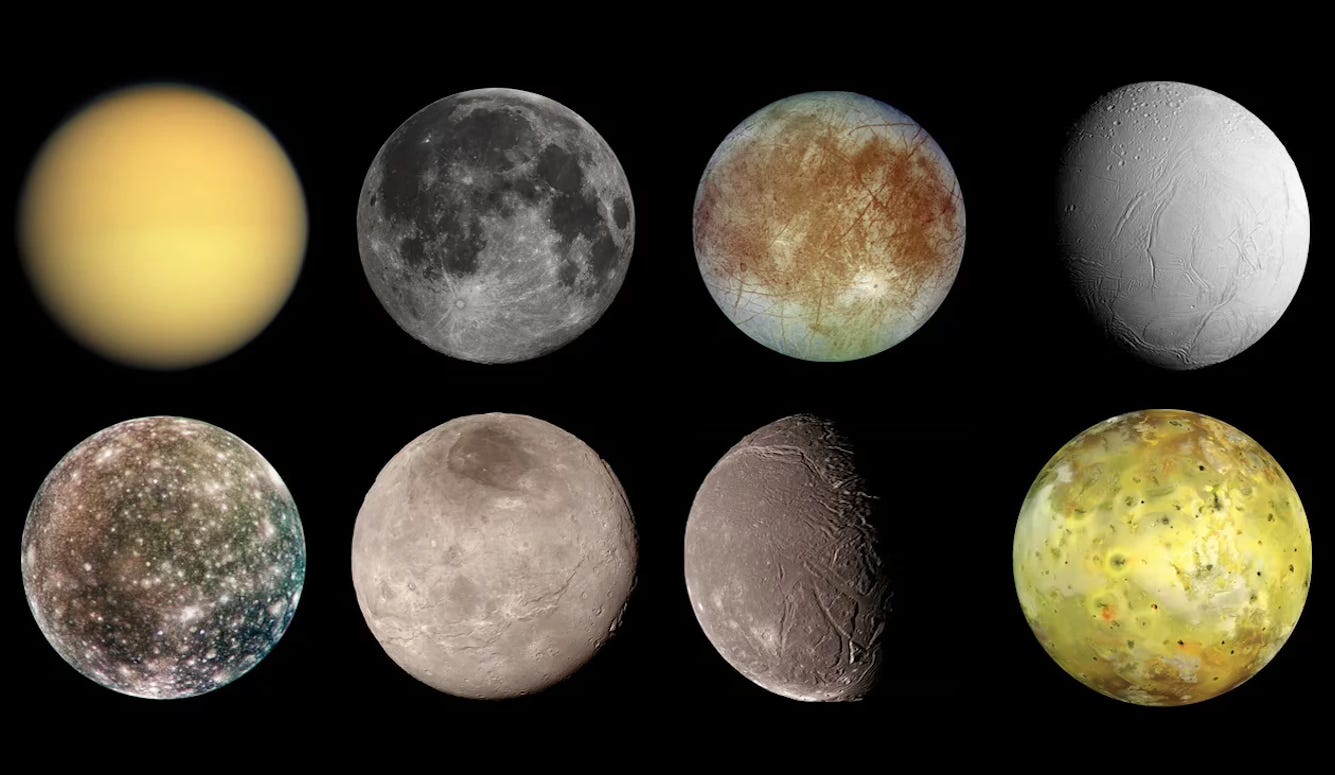
But in attempting to visualise 274 separate moons orbiting a planet, it’s worth considering that there are moons, and there are moons. Not all are created equal.
There are “regular” moons, and “irregular” moons. Moons of the former type, of which Saturn has 24, orbit the planet in almost circular paths, roughly around its equatorial plane, and follow the same direction as the planet rotates. Irregular moons are farther out, with highly elliptical orbits that are inclined away from the equatorial plane. They are also smaller than regular moons—some only a few kilometres across. Some are so “irregular” as to orbit in a direction opposite to the planet’s rotation.
The distinction goes beyond celestial aesthetics. The regular moons likely formed around Saturn at the same time as Saturn itself coalesced. The irregular moons, on the other hand, were likely minor planets that were later captured by Saturn’s gravity, or broken shards of such planets that may have collided together after they were captured. For this reason, learning about the nature of these different moons can help us understand the evolutionary history of Saturn.
➜ Read the full article at Quillette.com
Note: Quillette maintains its independence through reader subscriptions. You'll need a subscription to access the complete article.
 | A guest post by
|
I guess the real question is: would you grope them, Larry?