

Too Much Gilbert
The author of ‘Eat Pray Love’ has returned with a new memoir, which features all the usual problems with her writing writ large.

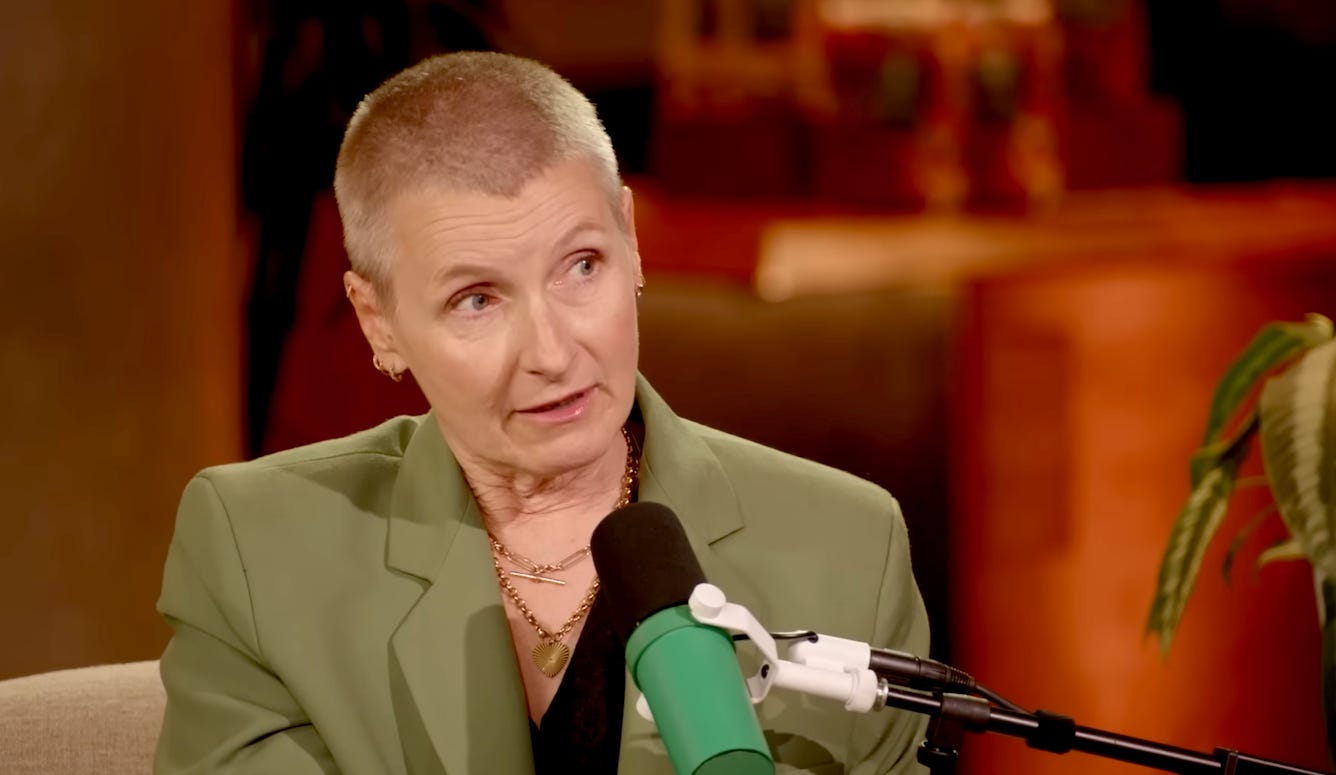
I.
Fifty-six-year-old Elizabeth Gilbert is one of the bestselling authors of this millennium. Her nine books—memoirs, fiction, and a 2015 self-help guide titled Big Magic for people who think of themselves as “creative”—have sold about 25 million copies between them. The top Elizabeth Gilbert seller of all is her 2006 offering Eat Pray Love: One Woman’s Search for Everything, which accounts for nearly half of her total book sales. Still in print after nearly two decades, it tells the story of Gilbert’s year-long, globe-circling quest to “find herself” after a bad divorce and an even worse post-divorce love affair. It spent nearly four years on the New York Times bestseller list and generated a hit 2010 film starring Julia Roberts as Gilbert and Javier Bardem as “Felipe,” the Brazilian import-export entrepreneur in Bali who became her new romantic interest in 2005 and her second husband in 2007. Uniformly terrible reviews notwithstnding, the movie grossed more than US$200 million on a budget of US$60 million.
Gilbert’s latest memoir, All the Way to the River: Love, Loss, and Liberation, appeared in early September of this year, and it tells the story of what happened after Eat Pray Love: a death-doomed lesbian affair with her longtime hairdresser and best friend, Rayya Elias—a Syrian-Christian immigrant nearly a decade older than Gilbert with a turbulent past that included addictions to cocaine and heroin and stints in jail. She had been clean and cutting Gilbert’s hair in lower Manhattan since 2000, when Gilbert was married to her first husband. In 2008, Elias was going through a divorce of her own from a lesbian marriage and was now out of work. So Gilbert moved her into a repurposed church in upstate New York that she had bought on a whim with some of her Eat Pray Love money. In lieu of rent, Gilbert instructed Elias to write her autobiography, and in 2013, the book was duly published (with an introduction by Gilbert) as Harley Loco: A Memoir of Hard Living, Hair, and Post-Punk From the Middle East to the Lower East Side. (Elias was a motorcycle fanatic and sometime rock guitarist and singer.)
Thereafter, Elias became Gilbert’s constant travel companion, doing her hair and makeup on book and lecture tours, but their friendship didn’t turn carnal until April 2016, when Elias was diagnosed with pancreatic and liver cancer and given six months to live. Upon learning this news, Gilbert initiated divorce proceedings against Bardem’s real-life counterpart (named José Nunes) and moved from the arty southern New Jersey town (where the couple had settled) into an East Village penthouse that she had rented as a love nest for herself and Elias. There, Elias fortified herself with cigarettes, alcohol, Xanax, Ambien, psilocybin, weed, and MDMA (the last six of which she shared with Gilbert on a regular basis). Later, when the pain kicked in and she relapsed into addiction, she added mind-boggling quantities of prescription opioids and street cocaine. She lasted a good year and a half longer than her predicted “expiration date,” as she called it. It was living “balls to the walls,” as she put it in her characteristic butch-dyke diction, and she didn’t die until early 2018.
I must admit that initially I had no intention of either buying or reading All the Way to the River, ever. I’m not a memoir aficionado to begin with (unless the writer is Joan Didion or St. Augustine) because I find the fixation on one’s self and its sufferings tedious. And I had avoided both the book and the movie adaptation of Eat Pray Love like I’d avoid a theme restaurant. I’m dead-certain, though, that of the 12 million copies of the book sold over the years, 11,999,999 of the purchasers were female. How many men want to read about a woman—and I’m quoting from the jacket blurbs here—who leaves her “husband, country house, successful career ... all these outward marks of success ... to explore three different aspects of her nature, against the backdrop of three different cultures: pleasure in Italy, devotion in India, and on the Indonesian island of Bali, a balance between worldly enjoyment and divine transcendence”?
Eat Pray Love seemed like a fantasy voyage for the legions of educated, affluent, middle-aged Western women (Gilbert was 34 when she undertook her journey) who gorge on carbohydrates (piles of pasta in Rome for Gilbert) after their boyfriends dump them or they divorce their dullard husbands to find hipper and better-looking mates, even though they themselves are past their peak. A few months of trendy Eastern religion—meditating in an Indian ashram, consulting Balinese folk-healers—makes them feel appropriately spiritual (but not so excessively spiritual that it might interfere with their thrilling new romantic lives). The decade or so preceding the publication of Eat Pray Love was a yoga-mat banner time for a conflation of genuine Eastern practice, New Age hoo-hah, and staying in shape via stretching and head-standing. Pema Chödrön’s When Things Fall Apart (1996) and T.K.V. Desikachar’s The Heart of Yoga (1999) were bestsellers among the self-care set. Eat Pray Love begat its own mindfulness-centric consumer culture: jewellery, perfume, teas, group tours of Southeast Asia’s mystical destinations. The palm-reading business of Ketut Lyer—a Balinese holy man who figures prominently in the book and was played by Hadi Subiyanto in the movie—reportedly boomed after the book’s publication.

 | A guest post by
|