

Treating Huntington’s
A new gene therapy that relies on gain-of-function research promises a breakthrough in neurodegenerative medicine and provides new hope for sufferers from a horrific disease. By Henry I. Miller

During my neurology rotation as a medical student, one of my first patients was in the middle stage of much-dreaded Huntington’s disease (HD), a hereditary, relentlessly progressive brain disorder that strips away movement, memory, and personality. It has been described as a cruel fusion of Alzheimer’s, Parkinson’s, and motor neuron diseases. HD is hereditary, and affected families have often felt hopeless, but last month, a group of English researchers, in collaboration with biotech company uniQure reported that an experimental gene therapy has dramatically slowed the course of the illness.
The Genetic and Molecular Basis of HD
HD is inherited as autosomal dominant, which means that each child of an affected parent has a fifty percent chance of inheriting the mutation. The mutation, which is caused by a DNA repeat expansion in the HTT gene on chromosome 4, is an extended sequence of nucleotides (the building blocks of DNA) called CAG (cytosine-adenine-guanine). That abnormal DNA sequence expresses a toxic form of the huntingtin protein that accumulates and gradually damages and kills neurons in parts of the brain, especially in the caudate and putamen parts of the basal ganglia.
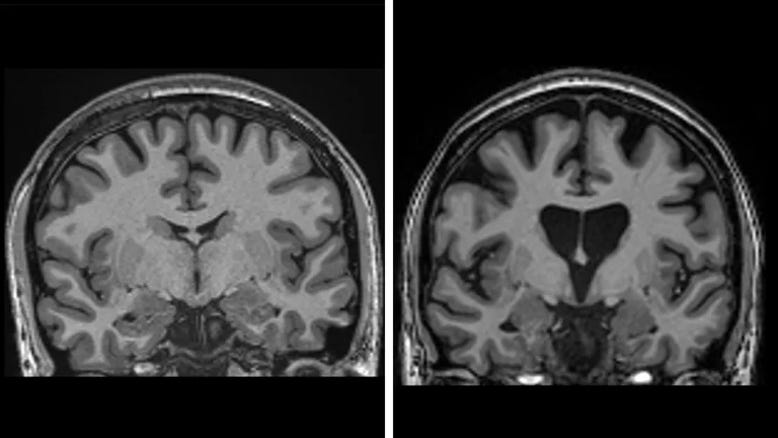
The Symptoms of HD
The symptoms most often begin in patients between ages thirty and sixty, while juvenile HD, which begins at earlier than twenty years of age, is rarer and tends to progress faster. Average survival is about 15–20 years after the onset of motor symptoms. The downhill course is characteristically grim.
The symptoms are of three general types:
Motor: chorea (involuntary, jerky movements), clumsiness, dystonia, impaired balance and eye movements; later, rigidity and swallowing difficulties.
Cognitive: slowed thinking, impaired executive function, difficulty with planning and multitasking, eventual dementia.
Psychiatric/behavioural: depression, irritability, anxiety, apathy; sometimes obsessive–compulsive features or psychosis. Sleep disruption and weight loss are common.
The diagnosis is made on the basis of a clinical examination plus genetic testing for the expanded HTT CAG repeat, which provides definitive evidence of the condition. For those at risk but without symptoms, predictive genetic testing is available, and is usually accompanied by extensive counselling.
