

Trump’s Gaza Plan
Donald Trump’s twenty-point peace proposal marks a potential turning point in the Israeli–Palestinian conflict—though whether it can be implemented remains uncertain.

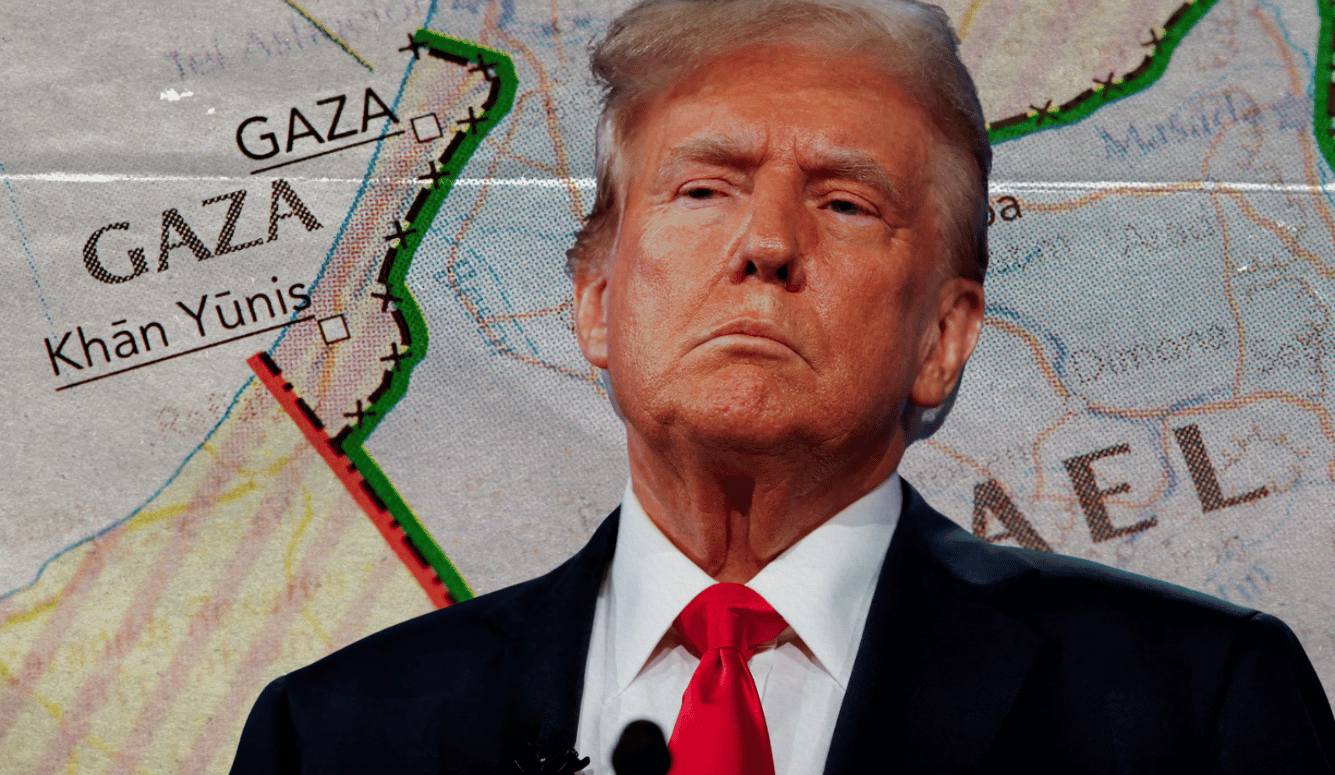
The problem of the future of the West Bank has overshadowed Israeli–Arab relations ever since 1967, when Israel captured the 2,180-mi² (5646-km²) territory from Jordan in the Six-Day War. It has loomed large in the background of the ongoing Israel–Hamas War since it began on 7 October 2023, when Palestinian terrorists invaded southern Israel and murdered 1,200 Jews and abducted 251 to the Gaza Strip, of whom 48 remain in captivity, twenty of them probably still alive. In all the projections of a possible two-state compromise solution to the Israeli–Palestinian conflict, the West Bank, with its around three million Palestinian inhabitants, necessarily serves as the core of the future Palestinian state.
But that territory, which Israel officially designates “Judea and Samaria,” was the core of the Jewish kingdom of David and Solomon three thousand years ago and of the Jewish or Judean polities that succeeded it over the following twelve centuries. And the area of Judea, the southern West Bank, contains the core religious sites of Judaism, including Jerusalem, Hebron, and Bethlehem, the birthplace of David.
Since 1967, Israeli officials have also argued that Israeli retention of the territory is crucial to the country’s security and survivability, given that the hills of Samaria and Judea topographically dominate Jerusalem, Israel’s capital, and overlook the core Jewish population centres of Israel’s coastal strip from Tel Aviv to Haifa, as well as Israel’s international airport at Lydda and countless other strategic installations. Foreign armies based or deploying in the West Bank could mortally threaten Israel and terrorists emerging from the West Bank could make Israel unliveable, as they almost succeeded in doing in 2000–2005, during the Second Intifada or Palestinian rebellion, when Palestinian suicide bombers struck restaurants and buses in Jerusalem, Tel Aviv, and Haifa almost daily.
So, in addition to historical and religious-ideological considerations, there is a need to take account of strategic and security factors. Plus, of course, there is the question of the 700,000 Jewish settlers who have been implanted in the territory in ever-growing numbers since summer 1967. These settlers have been in the West Bank for three generations. Many have lived there for all or most of their lives. Given that their continued existence in Judea and Samaria is supported by at least half the Israeli public, no Israeli government can realistically contemplate uprooting them—indeed, such an act could trigger a Jewish civil war. In 2005, when Israel’s then prime minister Ariel Sharon managed to uproot the recently established Jewish settlements in the Gaza Strip, it triggered a national crisis and caused deep psychological trauma to the Israeli Right—although only around 8,000 settlers were involved.
After 1967, the leaders of Israel’s governing centre-left Labour Party mulled over the possibility of a Palestinian state centred on the West Bank, but they were never able to reach an agreed policy, while Israel’s right-wing leaders, who have dominated the country’s politics since 1977, have consistently opposed the establishment of any such state. Israel has been occupying the West Bank and East Jerusalem for 58 years—something most Israelis would never have believed possible in 1967. And no one has been more adamant in rejecting Palestinian statehood than Israel’s current and longest-serving prime minister, Benjamin Netanyahu.
But the alternative solution—Israeli annexation of the West Bank down to the Jordan River—has always proved elusive, since the international community, who hope for an eventual two-state settlement, have vehemently and permanently vetoed the idea. America’s consistent veto of any such plan has been especially important. On 29 September, when President Donald Trump presented his twenty-point plan to resolve the Gaza War, he firmly stated that he would not permit Israel to annex the West Bank. Over the years, Trump has blown hot and cold on the subject, allowing Netanyahu to hope that the US administration might eventually back Israeli annexation. But it appears that this is Trump’s final word on the matter, which leaves Netanyahu’s supreme policy objective dead in the water.
For two decades now, Netanyahu’s successive governments—like most previous Israeli governments—have quietly pursued a policy that amounts to creeping annexation of the West Bank, through an ever-expanding Jewish settlement enterprise accompanied by land confiscations and infrastructure development, often ostensibly for security reasons, as well as the suppression of Palestinian nationalist activism and violence. Now, with the war with Hamas as cover, the creeping annexation has gained substantial momentum and settlers, backed by soldiers and police, have gnawed away at Arab villages and Bedouin encampments in the West Bank, gradually reducing the living space of the urban and rural Arab communities. These activities, which have been ineffectually condemned by the international community, have routinely involved the beatings of Arabs and destruction of their crops, especially their olive groves, as well as the frequent murder of Arab farmers and shepherds, while the Israeli state has done nothing to punish the perpetrators.
Now Trump’s twenty-point plan appears to be calling a halt to this process. On the face of it, the plan is directed at resolving the war in Gaza, but it is clear that it also directly affects the fate of the West Bank and Palestinian statehood. The plan stipulates that after an undefined temporary period during which the Gaza Strip would be subject to international administration, the territory would be ruled by a “reformed” Palestinian Authority (PA), the body that has nominally ruled parts of the West Bank alongside the Israeli military government since the Israel–PLO peace agreements of the 1990s. In Point 19, Trump’s plan envisages that, with a reformed PA in control of Gaza, “the conditions may finally be in place for a credible pathway to Palestinian self-determination and statehood.” For Netanyahu, this was probably a bitter pill to swallow—but, nonetheless, he has declared his acceptance of the plan, in the likely expectation that Hamas will either reject it or, at least, demand that key elements be negotiated. Any such negotiation would likely be protracted and probably end in disagreement, effectively killing the plan. Hamas would therefore be held responsible for the breakdown of the agreement, leaving Netanyahu free to push ahead with his plan to conquer the 25 percent of the Strip still held by Hamas, which contains almost all of the territory’s 2.3 million Palestinian inhabitants.
The timing of the announcement of the Trump plan was partly—or possible largely—due to the start of the new IDF offensive in Gaza City launched last month at Netanyahu’s insistence, against the wishes of most of Israel’s security chiefs, including the IDF Chief of General Staff Eyal Zamir. The army believe that the offensive will result in the deaths of a large number of IDF soldiers and of Palestinian civilians—though most of the one million or so Palestinians in the city have complied with IDF orders to evacuate to the south of the Strip. In addition, they fear it would lead to the deaths of some of the Israeli hostages, and would not destroy Hamas.
Trump’s plan calls for the cessation of all fighting in the Strip; the gradual withdrawal of Israeli forces from the 75 percent of the Strip Israel currently controls; the disarmament of Hamas and the end of its rule over the civilian population of Gaza; the release of all the Israeli hostages—both the twenty live and the around thirty dead hostages—along with the release of some 2,000 Palestinian prisoners currently held in Israeli jails, some 250 of whom are convicted murderers serving life sentences; amnesty for those Hamasniks willing to peacefully coexist with Israel and exile for the others; the delivery of massive humanitarian aid to Gaza’s civilians; and the establishment of a “temporary transitional” administration, consisting of “technocratic, apolitical” Palestinians and “international experts,” to be overseen by a “Board of Peace” chaired by Trump himself alongside a group of presiding or former heads of state, with British ex-premier Tony Blair at their head. These bodies would oversee reconstruction of the devastated territory and its infrastructure until such time as the reformed PA could take back control of the territory—control the PA lost in 2007, when it was bloodily evicted from the Strip by a Hamas coup. The Strip would be developed into a thriving economic polity, while the administration, backed up by unspecified military-police forces—Palestinian, Emirati, Saudi, Western?—defined as an “International Stabilisation Force” (ISF), would demilitarise the Strip—i.e., rid it of Hamas’s fighters, arms stockpiles, tunnel systems, and positions—while the IDF gradually withdrew to a “security perimeter” on the Gazan side of the Gaza–Israel border.
So far, Israel has announced its acceptance of the plan and ordered a halt to its offensive in Gaza City and a cessation of all bombing and artillery strikes, but its forces remain in situ. Israel has not announced its readiness to accept the ultimate establishment of a Palestinian state. Hamas has at least semi-officially announced acceptance of the plan but says several elements need to be “negotiated.” It has not announced a willingness to disarm, something its spokesmen have rejected since October 2023. How long this negotiating process could take is anyone’s guess; and whether Hamas’s reluctance to endorse the full plan signals its ultimate demise remains unclear.
On 23 September, Trump insisted that the war must end and was joined in this by his main allies among the Arab states: Qatar, Egypt, Jordan, and Saudi Arabia. But it is unclear how much leverage this coalition has over Israel and Hamas and whether it is willing to exercise this influence—say, by cutting off funds and munitions to the two sides.
Whether or not the Trump plan is ever implemented, it contains two perhaps unexpected salient points. First, Trump has stated that “No one will be forced to leave Gaza.” Anyone who does leave will be allowed to return and “we will encourage people to stay.” This is a 180-degree reversal of Trump’s stated aim in February 2025—endorsed by Netanyahu both at the time and since—that much or all of the Gazan civilian population should be encouraged or pushed to evacuate the territory. That “plan” fell by the wayside as the Arab world and the Western democracies immediately condemned the idea of transferring Gazans out of Gaza as a “second Nakba,” referencing the original Nakba (‘catastrophe’), in which some 700,000 Palestinians were uprooted from their homes in the territory that became Israel during the 1948 War, creating what was to become the “Palestinian refugee problem.”
The second salient point, covered in items 1 and 18, concerns the deradicalisation of both the Gazan and Israeli populations.

 | A guest post by
|